













































Introduction
Between 2019 and 2026, European bond markets underwent a pronounced structural adjustment, reflecting the cumulative effects of inflation shocks, policy tightening and the unwinding of a decade-long low-rate environment. Sovereign and corporate market segments repriced sharply as yields normalized and duration profiles compressed, while cross-country divergence—most notably between core and peripheral eurozone issuers—became increasingly evident. At the same time, Europe strengthened its role as the global center of green, social and sustainability (GSS) bond issuance, supported by a robust regulatory framework and expanding issuer participation. This paper provides a deeper examination of these developments, highlighting the distinct pathways through which European markets have transitioned toward a more stable, yet fundamentally redefined, fixed income landscape.
A Deeper Dive into the European Bond Market
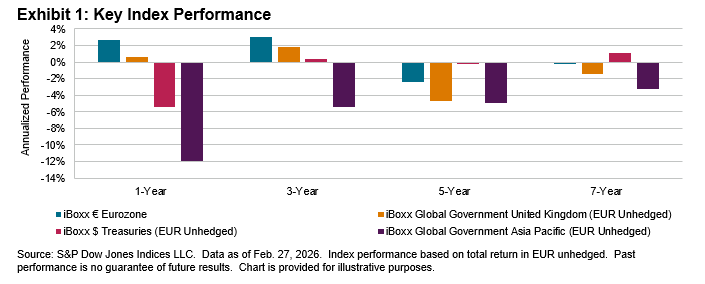
Between 2019 and 2026, global government bond markets underwent a structural reset, but the evolution of Europe and the U.K. has been markedly different from that of the U.S. and APAC. The comparison reveals how the combination of macro policy cycles, market expansion and in-yield adjustments reshaped performance and market composition over the period.
Among sovereign debt, the iBoxx € Eurozone index markedly outperformed across the short term (one- and three-year periods), while the iBoxx $ Treasuries (EUR Unhedged) index outperformed over the longer term (five- and seven-year periods), consistent with repricing dynamics. The eurozone outperformance was driven by normalized inflation and yield decline along with relative resilience. U.K. gilts, represented by the iBoxx Global Government United Kingdom (EUR Unhedged), demonstrated somewhat positive performance, reflecting a prolonged recovery from the 2022 gilt crisis and government spending announcements. By contrast, iBoxx $ Treasuries (EUR Unhedged) offered varying returns over the period driven by aggressive Fed rate hikes during the COVID-19 pandemic and duration adjustment. Finally, the iBoxx Global Government Asia Pacific (EUR Unhedged) performance offered insight into a fragmented market, shaped by divergent monetary policies and structural differences across countries. While some markets maintained accommodative policies for longer—most notably under the yield-curve control framework of the Bank of Japan—others experienced tightening cycles more aligned with global trends. As a result, the region’s performance and structural evolution were less uniform than those observed in Europe or the U.S.
