


29 January 2025 | 04:05 UTC — Insight Blog
Asia's top emitters show limited progress in meeting 2030 reduction targets
Energy transition highlights: Our editors and analysts bring together the biggest stories in the industry this week, from renewables to storage to carbon prices.
The top greenhouse gas emitters in Asia – China and India -- have submitted their inaugural biennial transparency reports, highlighting the challenges they face on the path to achieving their 2030 emission reduction targets.
The biennial transparency reports, a UN-initiated reporting instrument to track individual countries’ emissions as well as progress in meeting their nationally determined (NDC) contributions, namely the climate targets committed under the Paris Agreement, shows Asia’s overall decarbonization progress appears far from satisfactory.
In the latest biennial transparency reports, China reported that by 2021, it had reduced its carbon intensity by 50.9% from the 2005 level. Meanwhile, India reported a 36% reduction in carbon intensity from the 2005 level as of 2020.
Both nations have utilized the reduction in carbon intensity -- defined as the decrease in carbon emissions per unit of gross domestic product -- as the benchmark for establishing their NDCs. By 2030, China has pledged to reduce its carbon intensity by 65% from the 2005 level, while India has committed to a 45% reduction from the same base year.
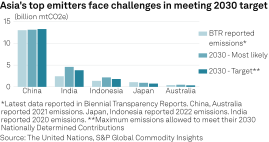
According to S&P Global Energy Inflection Scenario forecasts, China’s carbon intensity is projected at 441.2 mtCO2 per real million dollars by 2030, slightly outperforming the NDC requirement of 446.6 mtCO2 per real million dollars. In contrast, India’s carbon intensity is expected to be 618 mtCO2 per real million dollars by 2030, indicating a significant shortfall in meeting the NDC target.

Based on available data, weekly average China Certified Emissions Reduction Program prices were Yuan 89.45/mtCO2e ($12.44/mtCO2e) at Shanghai Environment and Energy Exchange, Yuan 83.23/mtCO2e ($11.58/mtCO2e) at Sichuan United Environment Exchange, and Yuan 71.64/mtCO2e ($9.97/mtCO2e) at China Emissions Exchange (Shenzhen), according to MVGX.
Editor’s picks: Premium and free content
Asia’s decarbonization momentum should persist despite US about turn: experts
Asia's decarbonization momentum will likely continue despite the shifting landscape created by Donald Trump's moves to unwind climate-oriented policies, with the new president signing a slew of executive orders on his inauguration day withdrawing the US from the Paris climate deal, curbing provisions of the Inflation Reduction Act and freezing offshore wind energy development in the country, according to policy experts. In this scenario, China and the EU are seen driving the global energy transition through clean energy technology and rigorous carbon pricing mechanisms, to fill the void left by the US, and continue to drive their own long-term commitments to climate actions.
World close to target of tripling renewables by 2030, energy efficiency lags: IEA
The world is on track to triple renewable energy capacity by the end of the decade but is failing on energy efficiency, according to Fatih Birol, head of the International Energy Agency. Renewable capacity is set to grow 2.7 times globally by 2030, close to the target of tripling additions by that date set at the UN Climate Change Conference in the UAE in 2023, Birol said at the World Economic Forum in Davos, adding, the pace of additions could yet accelerate to meet the 2030 target. Energy and climate think tank Ember told S&P Global Energy the gains were thanks to the global boom in solar deployment and there were two caveats: renewable generation must not underperform; and efficiency gains must accelerate.
INTERVIEW: Carbon pricing is California’s more 'affordable' climate policy amid high energy costs
Continuing California's carbon market past its 2030 end-date may be the state's most "affordable" climate policy option as legislators look to ease high energy costs, according to Meredith Fowlie, associate professor of agriculture and economics, at University of California, Berkeley. Reauthorizing California greenhouse gas cap-and-trade program past 2030 would allow the state to maintain an incentive to reduce reliance on fossil fuels in an affordable manner, the professor said. California's carbon market is experiencing significant uncertainty, causing disruptions in carbon pricing. The California Air Resources Board was previously expected to release a proposal in 2024 for new regulations that would tighten the high-supply program and introduce new caps in 2025, but multiple delays were announced.
TotalEnergies CEO calls for EU policy protection against Chinese SAF imports
TotalEnergies CEO Patrick Pouyanne has called on EU regulators to support premium prices for Europe’s low-carbon fuels market, or risk offshoring its transitioning refining sector to growing producers such as China. Speaking at the World Economic Forum in Davos the CEO of the French energy company said Europe needs to adapt its consumer-centric stance on fuels and offer stronger protection for its producers, despite the inflationary effect on prices. The European decarbonization policy has so far focused mostly on demand-side levers, guaranteeing uptake of clean energy alternatives with measures such as a ban on conventional ICE vehicles from 2035 on and new sustainable aviation fuel mandates.
Learn more about S&P Global Energy Energy Transition Services

Subscribe to this newsletter on LinkedIn
to get weekly updates on the biggest stories
in energy transition