Crude Oil, Refined Products, LNG, Energy Transition, Natural Gas, Agriculture, Diesel-Gasoil, Jet Fuel, Carbon
December 02, 2025
COMMODITY TRACKER: 4 charts to watch this week

By Staff
As sanctions tighten, Russia aims to strengthen energy ties with China, while Singapore's gasoil and jet fuel markets respond to potential peace negotiations in Ukraine. Additionally, funds are moving out of European gas towards carbon EU Allowances as LNG supply rises.
1. Russia seeks closer China energy cooperation amid sanctions
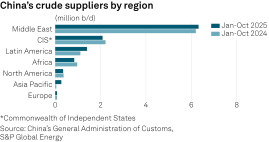
What's happening? Russian officials are calling for closer cooperation with China, including expanding long-term hydrocarbon supply contracts, as Western countries ramp up sanctions on the Russian oil sector. Russia is China's biggest crude supplier, but exports fell 7.7% year over year in the first 10 months of 2025 to 2 million b/d, according to data from China's General Administration of Customs. Russian exports are facing increased competition from discounted Iranian crude. US sanctions on Russian oil giants Rosneft and Lukoil took effect on Nov. 21, in a move that could disrupt Russia's oil exports, including to China.
What's next? Rosneft and Lukoil account for over half of Russia's oil production and crude exports and are now subject to a full transaction ban and potential secondary sanctions on the companies' trade partners. Some sanctions waivers have already been issued and more could follow. In the coming months, the impact of these restrictions on Russia's exports to China will become clear. S&P Global Energy expects partial sanctions enforcement to widen the discount on Russian crude, increase transportation costs, and lead to fewer barrels being exported.
2. Singapore gasoil and jet fuel markets react to Russia-Ukraine peace negotiations
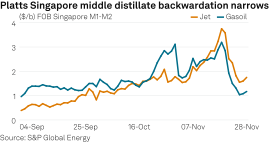
What's happening? Singapore gasoil and jet fuel/kerosene time spread swaps sharply declined as market sentiment weakened following US President Trump's involvement in a Russia-Ukraine peace plan. Platts assessed the FOB Singapore gasoil M1/M2 time spread at 90 cents/b, while the jet/kerosene spread narrowed to $1.33/b. Platts is a part of S&P Global Energy. Earlier, sanctions on Russian gasoil and Ukrainian drone strikes on Russian refineries had driven a widening in the spreads.
What's next? If a peace deal between Ukraine and Russia is reached, it could alleviate the risk premium and potentially restore disrupted Russian middle distillate exports."Recent sanctions on Russian oil companies have created potential downside to global diesel supply, given Russia's position as the world's 2nd largest exporter," said Morgan Stanley analysts. The EU's upcoming sanctions package, effective Jan. 21, 2026, will ban imports of refined products from Russian crude. According to a Nov. 18 announcement from Intercontinental Exchange, which operates the benchmark European diesel/gasoil contract, the exchange will no longer accept diesel from refineries that have processed Russian crude within the past 60 days.
3. Funds pivot towards carbon EUAs as LNG supply impacts European gas prices
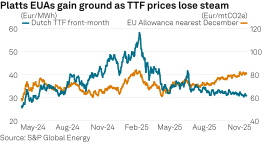
What's happening? Funds are rotating out of European gas and into EU carbon as expectations of a 2026 LNG supply increase push TTF prices lower and break the long-standing gas-carbon link. Front-month TTF has fallen around 40% this year amid steady LNG inflows, record US exports, and storage near 78%, while EUAs have held above Eur80/metric ton CO2e. This shift is mirrored in positioning, as funds cut Dutch gas net longs to the weakest level since March 2024 while increasing EU Allowance net longs to the highest since 2021.
What's next? Looking ahead, expanding global liquefaction capacity and muted demand are expected to maintain bearish pressure on gas through 2026. Carbon prices face tightening supply as the Market Stability Reserve withdraws more allowances, auction volumes shrink and free allocations decline under CBAM and ETS reforms. S&P Global Sustainable1 analysts expect EUAs to average around Eur85/mtCO2e in 2026, supporting continued bullish sentiment.
4. European sugar prices hit multi-year lows
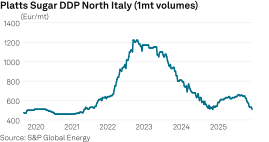
What's happening? Since early September, European sugar prices have been on a downward trend, coinciding with the start of the harvest campaign. Platts assessed DDP North Italy sugar prices at Eur505/mt Nov. 27, marking the lowest level since October 2024 and reflecting ongoing bearish sentiment. Demand has been low throughout the season, and crop yields have been good due to optimal weather conditions, meaning producers are facing oversupply. Low global market prices and pressure from duty-free Inward Processing Relief sugar imports from the global markets are also pushing prices down. IPR is a policy mechanism, that allows sugar to be imported duty-free and without quantitative limits when it is processed into food or other products within the EU and then re-exported outside the EU.
What's next? In response to the price decline, market participants are implementing strategies to support recovery. Major European sugar producer Südzucker is offering financial incentives to beet growers to reduce acreage for 2026. Participants have also called on the European Commission to suspend raw IPR sugar imports into the EU to aid price recovery after a member state expressed concerns in a meeting Oct. 30, as IPR sugar is priced competitively to domestic prices.
Reporting and analysis by Rosemary Griffin, Oceana Zhou, Wang Yue, Irina Breilean, Sakshi Jalan, Anna Kirillov

Editor: