











































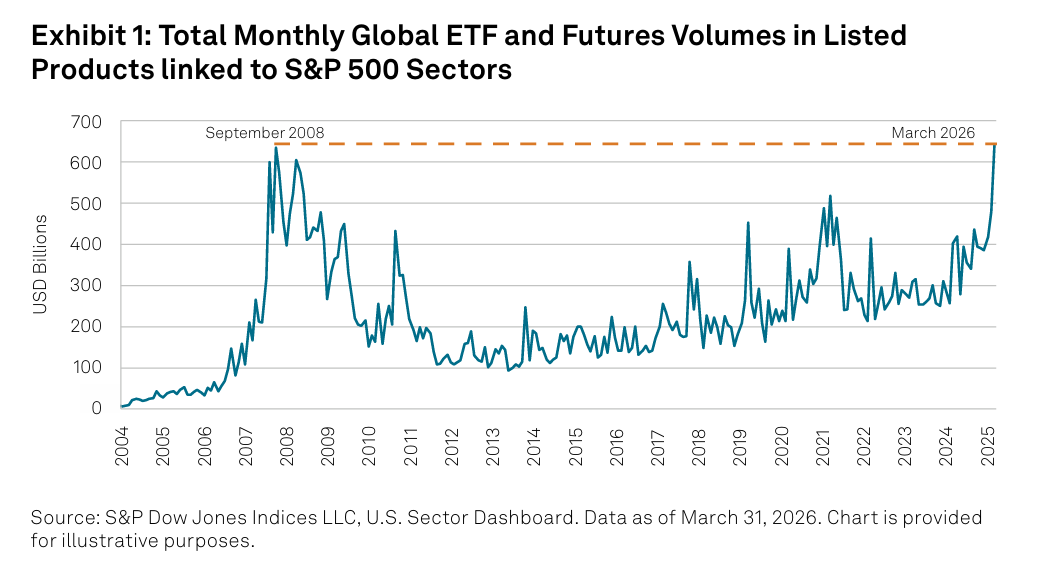
Volumes associated with listed products tracking S&P 500® sectors rose to USD 643 billion in March 2026, breaking a monthly record that had stood since September 2008.
1. With a handful of mega-cap names and their strategic partners continuing to drive much of U.S. equity market performance, why might investors consider drilling down into other sector segments?
The concentration of performance in a small cluster of mega-cap names has been one of the defining features of the current market regime, but it is precisely this dynamic that makes sector perspectives increasingly relevant. When leadership narrows, investors implicitly take on greater idiosyncratic risk, even in passive allocations. In that context, sector exposures can offer a way to rebalance risks, to diversify sources of performance or to protect against perceived threats of poor (or under-) performance.
Headline index performance can often mask substantial variation beneath the surface and, historically, sectors have played a central role in driving differential equity performance in both high and low volatility periods. Sector dispersion typically reaches elevated levels during periods of market disruptions and rotations and, while finding benchmark-beating stocks is notoriously hard, our own research shows that since the late 1990s, a majority of U.S. sectors outperformed the headline benchmark. What distinguishes the current environment is less an absence of potential and more the degree of differentiation among performance in different market segments.
There is also a structural dimension. Sector allocations allow investors to express views on macroeconomic and geopolitical themes, reflecting different sensitivities to economic cycles, input costs and various earnings drivers such as tariffs, taxes, innovation and much more. For example, consumer inflation and confidence measures find correlations in the relative performance of the Consumer Staples and Consumer Discretionary sectors. Rising energy prices are a challenge to most companies, but not to the Energy sector, which notably zigged as the rest of the market zagged in the early months of the Russia-Ukraine war and continues to display distinct performance in response to the evolving peace negotiations in the Middle East.
Ultimately, drilling down into sectors is less about abandoning the market narrative and more about refining it, isolating the drivers of risk and return at a level that balances diversification across companies with differentiation across economic exposures.
2. Which risks are investors trying to manage through sectors today, from energy prices and inflation to tariffs and AI concentration?
Sector allocation has always been closely linked to macro risk management, but today’s environment is notable for the number of overlapping risks investors are navigating simultaneously. Alongside AI and geopolitics, inflation and energy dynamics remain central. Energy, for instance, is a relatively small portion of the S&P 500 by market capitalization, yet it is disproportionately important when it comes to hedging commodity price shocks and inflationary pressures. Our recent publications, including the U.S. Sector Dashboard, have highlighted this divergence between sector weight and trading activity; in April, for example, Energy accounted for just 3.5% of the capital invested in the S&P 500, but around 20% of all trading volume in listed products associated with the S&P 500 Sector Indices.
Geopolitical risk and tariffs add another dimension. The Industrials and Materials sectors, as well as parts of the Technology Hardware sub-industry, have differing sensitivities to supply chain disruptions and trade policy shifts. Sector positioning allows investors to adjust exposures without needing to take security-level views on individual companies affected by these dynamics.
The most prominent risk in investors’ minds, however, is perhaps concentration tied to AI. The perceived beneficiaries of AI primarily compose a relatively small subset of large-cap technology firms, which themselves have driven a significant share of index performance. Sector strategies offer a way to disentangle that exposure: investors can isolate technology exposure, diversify within it via equal weighting, or rotate into adjacent sectors or subsectors, such as Communication Services or Semiconductors, that participate in the trend at different points in the value chain.
More broadly, sector indices provide a toolkit for managing both cyclical and defensive positioning. Historically, defensive sectors have shown resilience during market downturns, while cyclical sectors have tended to lead in expansions. This cyclical sensitivity remains highly relevant in an environment where economic visibility is still evolving.
