










































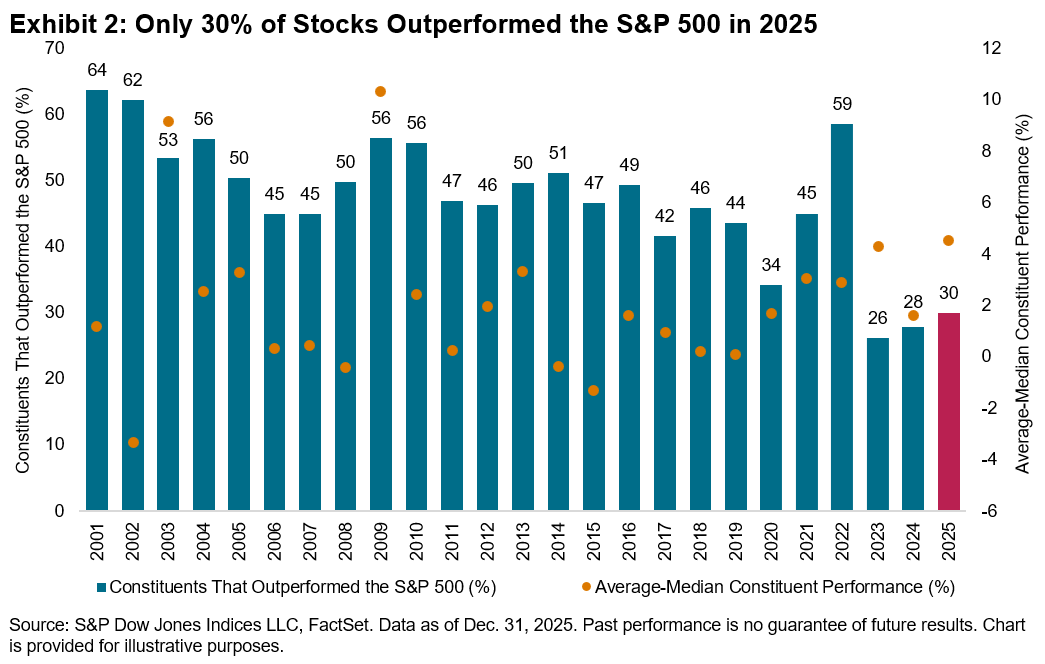
Recent market commentary has declared that 2025 was a brutal year for stock picking, with USD 1 trillion pulled out of active equity mutual funds during the year, according to the Investment Company Institute. The year was characterized by sharp double-digit swings for the S&P 500®, and in such environments filled with bouts of volatility, we would naturally have expected active managers to shine.
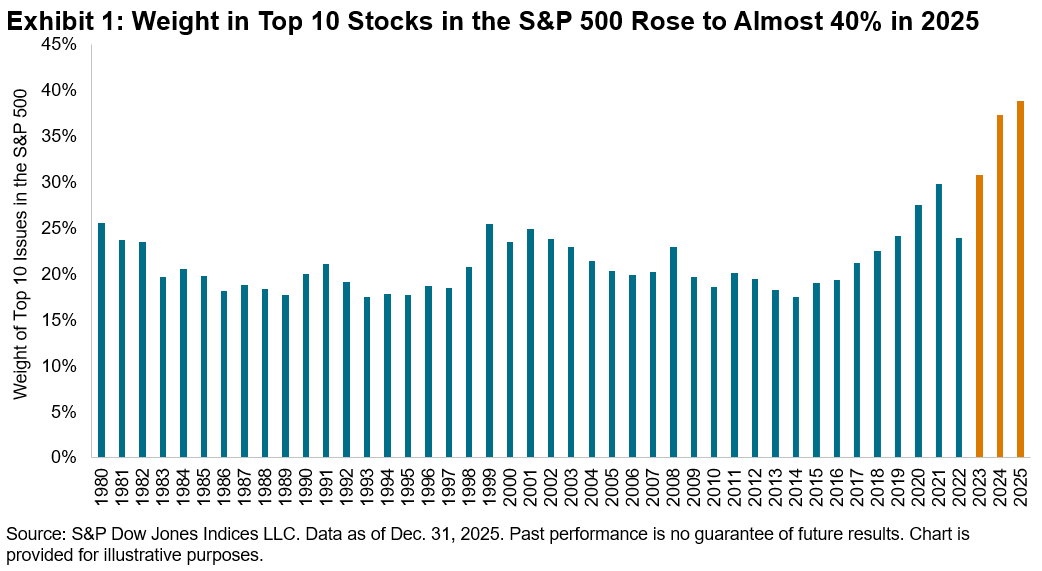
So what might explain this lackluster performance? One notable headwind, especially over the past three years, has been the outperformance of the S&P 500's largest constituents. As a result, the weight of the top 10 stocks in The 500® has climbed accordingly, from 31% in 2023 to almost 40% in 2025. If active managers were underweight the largest stocks, then they were more likely to underperform.
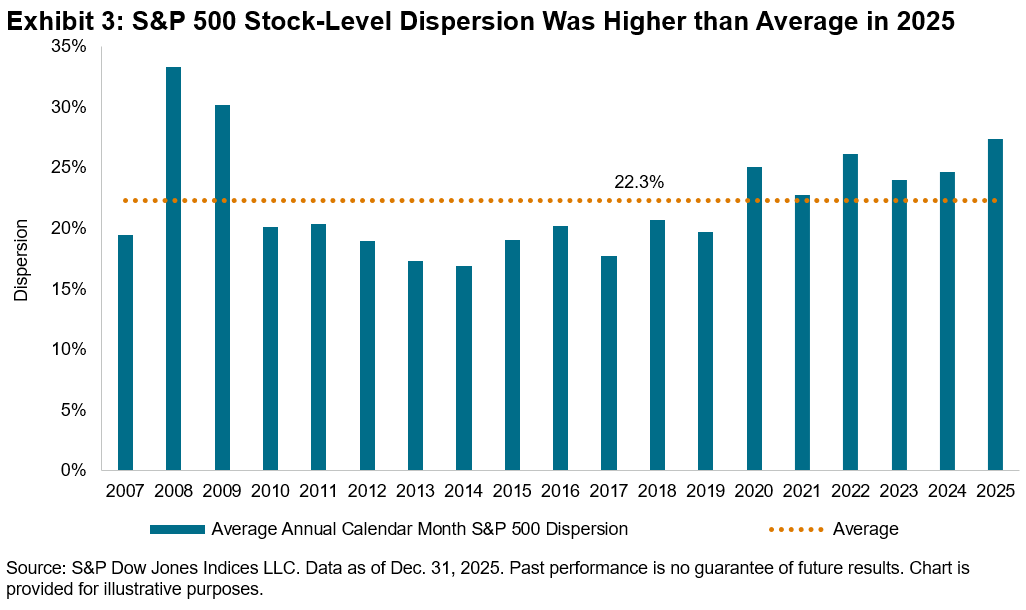
Despite these obstacles, one silver lining may have been the rise in cross-sectional volatility, or dispersion, which measures how differently stocks are performing relative to each other. The value of stock-selection skill rises when dispersion is high, which could have meant greater opportunities for skillful stock pickers to outperform. Exhibit 3 shows that large-cap stock-level dispersion in 2025 was higher than the historical average and the prior two years. We know from our SPIVA® U.S. Mid-Year 2025 Scorecard that 46% of large-cap funds outperformed the S&P 500 in H1 2025,1 evidence that there were opportunities for stock pickers to shine, particularly during the tariff-related turmoil in the first half of the year.
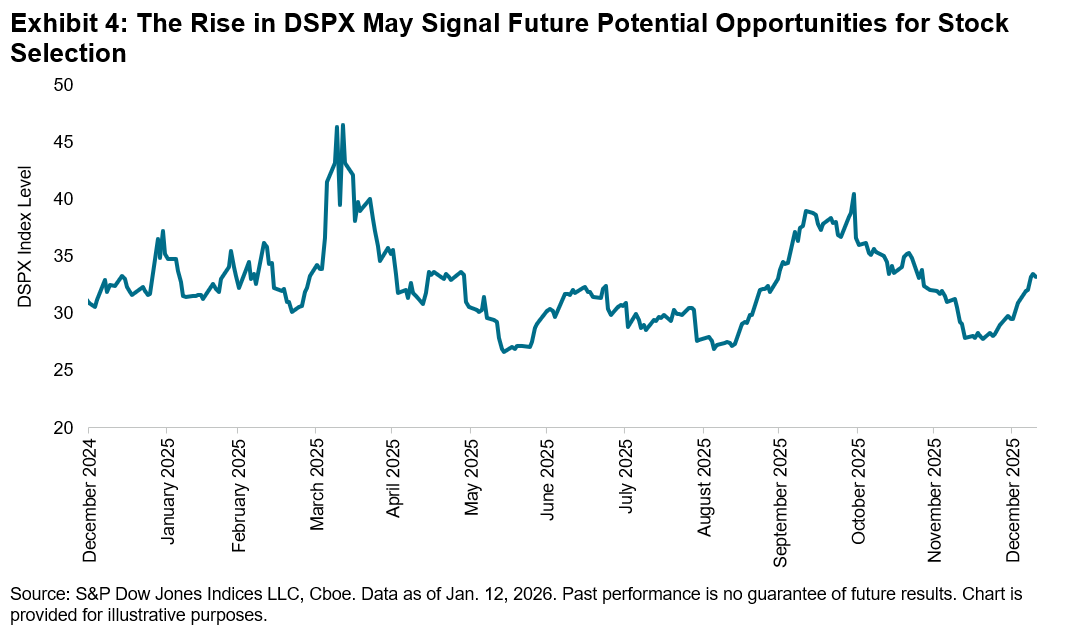
As we begin 2026, we can look to implied dispersion to understand the potential for future opportunities for stock selection. We observe in Exhibit 4 that the Cboe S&P 500 Dispersion Index (DSPX), which uses listed options to measure the expectations for dispersion over the next 30 calendar days, rose to 33.81 as of Jan. 12, 2026. This means the market expects that the spread of annualized S&P 500 stock returns will have a standard deviation of 34% over the next month and, especially as we approach Q4 earnings season, could signify positive prospects. Another potential tailwind may be the recent broadening of the rally, with the S&P SmallCap 600® up 3% since the start of the year compared to The 500.
The current environment may be fortuitous, but forecasting future active manager performance may be as or even more challenging than predicting future market performance. For those who have declared 2026 to be the year of the stock picker, a reminder that we heard similar proclamations at the end of 2024 and in many years prior, but as we know from our SPIVA Scorecards, majority underperformance remained the norm more often than not.
1 Please stay tuned for the SPIVA U.S. Year-End 2025 results.
The posts on this blog are opinions, not advice. Please read our Disclaimers.