


Crude Oil
August 13, 2025
FUEL FOR THOUGHT: OPEC rails against peak oil demand threats, but its own investments bear watching

By Herman Wang
It should come as no surprise that OPEC, the petroleum exporters bloc, is bullish on the future of oil.
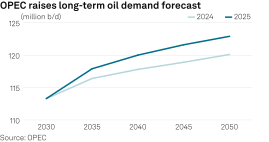
The organization has made it a mission to rebut any notions of peak demand, and in its latest World Oil Outlook, it forecast that global oil consumption will keep rising through at least 2050 to hit 122.9 million b/d – up nearly 20% from current levels.
The report, unveiled July 10 at OPEC’s glitzy 9th International Seminar in Vienna, came with a dire warning that the world will need to invest a staggering $18.2 trillion over the next 25 years to meet its thirst for oil.
Calls to halt financing oil projects could jeopardize world order, as will unrealistic government policies that seek to throttle the use of fossil fuels, OPEC intoned.
“The challenge of meeting these investment requirements is huge, and any shortfall in meeting these needs could impact market stability and energy security,” the World Oil Outlook stated.
But if its own predictions of oil demand come true, then OPEC itself, along with its allies in the OPEC+ coalition, needs to get investing.
The analysis shows that the call on OPEC+ liquids, including NGLs, will rise from 49.1 million b/d in 2024 to 64.1 million b/d in 2050.
That is, the 22 OPEC+ countries will have to supply some 15 million b/d more crude and NGLs by 2050 to keep the market balanced and prevent a global oil squeeze. How the alliance will get there is not illuminated in the report.
Analysts with S&P Global Energy estimate OPEC+ will hold about 4.8 million b/d of spare production capacity in 2026, all of it concentrated in Saudi Arabia, the UAE and Kuwait. That leaves just over 10 million b/d of new capacity needed, not to mention the drilling necessary to backstop natural reservoir declines.
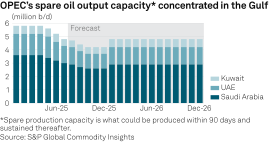
But of the OPEC+ members, only the UAE has a concrete expansion plan, for state-run Abu Dhabi National Oil Co. to hit 5 million b/d of capacity by 2027, up from its current 4.85 million b/d.
Beyond that, ADNOC has been mum, though officials have hinted that further additions could come, perhaps up to 6 million b/d. However, the official Emirati news agency WAM on July 10 stated there were no current plans to go beyond the 5 million b/d target.
Saudi Aramco, the world’s largest exporter of crude, is staying at a capacity of 12 million b/d, having canceled in January 2023 investments planned to get up to 13 million b/d on orders of its government.
Gains from new drilling in the Dammam field, which came online earlier this year, as well as planned developments at the Berri and Marjan fields set for completion in the coming months, will merely replace declines elsewhere in Aramco's portfolio, the company said in its most recent earnings report Aug. 5.
"Hydrocarbons will continue to play a vital role in global energy and chemicals markets, and we are ready to play our part in meeting customer demand over the short and the long term,” CEO Amin Nasser said on a call with analysts, without elaborating on the company's strategy.
Other OPEC+ countries have vague production targets but are beset by money woes, government inertia, sanctions, or unfavorable geology.
Waiting out shale
Perhaps the alliance is waiting for the US shale story to peter out before putting its own money into expanding its production capacity, rather than fighting a bruising market share battle against American short-cycle barrels.
The World Oil Outlook forecasts that after some rapid growth in the coming decade, crude production outside of OPEC+ members, much of it from the US, will level off from the mid-2030s, plateauing just under 60 million b/d through 2050.
That will take the OPEC+ share of global liquids supply from 48% in 2024 to 52% in 2050, as the bloc theoretically boosts production to meet growing demand from the likes of India and the emerging economies of Africa and the Middle East.
To be sure, OPEC’s World Oil Outlook, with its rejection of peak demand, is an aggressive – and arguably outlier – long-term forecast.
Many other market watchers, notably the International Energy Agency, see oil demand peaking within the next decade if not sooner, thanks largely to an expected increase in electric vehicle adoption. Analysts with Energy project liquids demand to steadily decline after 2031.
But OPEC says its faith in its forecast, which is an upward revision from last year’s World Oil Outlook, is based on its observations of countries across the globe prioritizing energy security over decarbonization, as fraught geopolitics have fanned fears of supply shortages and disruptions.
Pushes by environmentally minded governments and investors to swiftly phase out oil and gas consumption have been shown to be “unworkable and a fantasy,” OPEC Secretary General Haitham al-Ghais said in the report.
“Many initial net-zero policies promoted unrealistic timelines or had little regard for energy security, affordability or feasibility -- this mindset is shifting,” he said.
'Not investing enough'
Speaking on the sidelines of OPEC’s International Seminar -- a two-day celebration of oil’s role in society, with a who's who of the industry present, including CEOs, government officials and thought leaders -- UAE energy minister Suhail al-Mazrouei sounded the alarm that the market could have “a problem down the road” if it does not see sufficient upstream investment.
And he pointed to the big oil producers themselves as central to the plot.
“Countries which have the majority of the underground oil in terms of reserves are not investing enough because they are not seeing the price maybe that they want,” Mazrouei said. “We, as the UAE, have been investing. We know that we will see requirements for those barrels.”
It was said in defense of the OPEC+ alliance’s strategy to maintain production discipline in the short term, to prop up crude prices in the name of attracting upstream development, as ministers have repeatedly maintained the market would be far lower without the group's sacrifices.
But it is also a message on investment that would appear necessary for the group itself to heed, if OPEC’s vision of a world that continues to be fueled by oil comes to fruition.