


Crude Oil, Agriculture, Energy Transition, Biofuel, Renewables
August 12, 2025
COMMODITY TRACKER: 5 charts to watch this week

By Staff
OPEC+ production is in focus, while market observers are monitoring China's appetite for Russian supply. S&P Global Energy reporters and editors are also monitoring Mexico's ferrous scrap demand, European renewable diesel prices, and milling wheat stocks.
1. Saudi Arabian crude output growth outstripping Russian supply
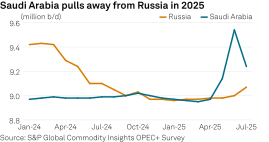
What's happening? Saudi Arabia, OPEC's biggest crude producer, is bringing barrels back to market faster than Russia -- the largest non-OPEC producer taking part in the OPEC+ crude output agreement. While Russian output is stymied by Western sanctions imposed in response to Russia's invasion of Ukraine, Saudi Arabia is able to capitalize on quota increases. Overall, OPEC+ crude output fell to 41.65 million b/d in July, a decrease of 140,000 b/d from June. This drop followed contingency measures to address potential supply shocks from the Iran-Israel conflict, which bolstered output in June.
What's next? If OPEC+ sticks to current plans to accelerate quota increases, analysts expect Saudi Arabia to continue to increase production faster than Russia. S&P Global Energy analysts forecast that Saudi production could be 800,000 b/d more than Russian from September, when OPEC+ plans to fully phase out 2.2 million b/d of voluntary production cuts. These cuts are being implemented by a group of eight producers, including Saudi Arabia, Russia, Iraq, Kuwait, the UAE, Oman, Kazakhstan and Algeria. The group is next scheduled to meet on Sept. 7 to discuss market conditions, compliance, and compensation. It can change policy at any time if delegates think that market conditions require a change in strategy.
Related content: OPEC+ cuts July crude output by 140,000 b/d after bumper June
2. China's appetite for Russian oil in focus ahead of Trump-Putin meet

What's happening? US President Donald Trump has warned of more secondary sanctions to come for countries buying Russian energy products, after slapping a 25% tariff on India effective Aug. 7. With India widely expected to diversify its crude sources due to the additional tariff, sources said China's refineries may be able to absorb Russian supply given up by Indian buyers. Monthly Russian crude imports by China once hit a record high of 2.27 million b/d in 2023 when other buyers stayed sidelined due to the G7's price cap.
What's next? China's Russian crude volume dropped 10.4% year over year in the first half of 2025, and sources said the volume of Russian crude barrels they can absorb depends on how low the price can go and whether secondary sanctions are imposed, a Beijing-based analyst told Platts. Eyes are now on the upcoming meeting between Trump and Russian President Vladimir Putin, who are expected to discuss on Aug. 15 how to end the war in Ukraine, and how the talks could potentially impact energy trade.
3. Mexican ferrous scrap demand to surge following ArcelorMittal's temporary shutdown
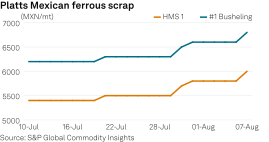
What's happening? ArcelorMittal temporarily suspended its blast furnace due to critical boiler failures, shifting to scrap-based steel production. This has prompted Mexican scrap buyers to increase bids by up to Peso 600/mt and rebar producers to announce price hikes of up to Peso 1,000/mt. The Platts assessment for Mexican ferrous scrap has risen Peso 500/mt since July 29, the day before ArcelorMittal's announcement.
What's next? With the country's only blast furnace offline, all steel production in Mexico will shift to electric arc furnaces. Market participants expect Mexican producers to absorb at least half of ArcelorMittal's production, potentially increasing scrap demand by 30,000 mt/month. This shift will likely drive further price increases as demand ramps up. The rising demand will worsen the deficit between scrap consumption and generation in Mexico, necessitating increased imports. April saw a record 137,140 mt in scrap imports and if US demand shifts toward Mexican scrap, it could compete with local supply.
4. Falling Asian imports push European renewable diesel prices above SAF
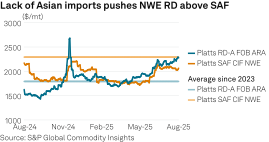
What's happening? Lower Asian imports throughout 2025 have pushed renewable diesel prices in Europe above those of sustainable aviation fuel, inverting the historic pricing relationship of the two fuels. Platts, part of S&P Global Energy, assessed the RD-A outright price at $2,290.75/mt on Aug. 6, the highest since November. It edged down to $2,277.50/mt Aug. 7 but remains well above SAF prices in the region. RD has been pricing above SAF since April, buoyed by a lack of imports. The CIF NWE Sustainable Aviation Fuel outright price was assessed Aug. 7 at $2,063.50/mt, having reached lows of $1,715.15/mt on May 7. The SAF assessment has averaged $2,292/mt since it was launched in September 2023, while the RD assessment has averaged $1,792/mt over the same period.
What's next? Renewable diesel prices in the Amsterdam-Rotterdam-Antwerp hub hit a nine-month high Aug. 6, as EU antidumping measures continued to curb imports while market participants report tight prompt physical supply. Further, strong demand is expected through the end of the year as obligated parties seek to stock up on volumes of advanced biofuels ahead of incoming regulatory changes stipulated in revised RED III proposals, set to take effect from 2026 onward.
5. Milling wheat sees initial price drops; quality, supply concerns persist
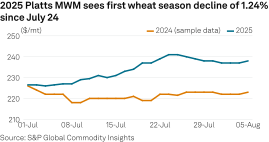
What's happening? The Platts Milling Wheat Marker fell to $238/mt Aug. 5, down 1.24% from July 24, marking the first decline since the new marketing year began in July. The drop was primarily due to weaker demand, but traders said concerns over quality and supply in Russia and Ukraine could limit significant declines in the short term
What's next? Russian sellers said low stocks, harvest delays and low yields in southern Russia are key factors in preventing further price declines. Producers, meanwhile, are hesitant to sell, hoping for higher carriage-paid-to bids from exporters. Despite these concerns, buyers remain optimistic about further price drops as more wheat is harvested, particularly from Russia's central and Volga regions. In July, the MWM averaged $233.21/mt, with Russian 12.5% protein wheat priced at parity and maintaining that parity so far in August.
Reporting and analysis by Rosemary Griffin, Oceana Zhou, Helios Ocana, Thomas Washington, Olly Wroe, Vivian Iroanya

Editor: