


Crude Oil, Maritime & Shipping, Agriculture, Metals & Mining Theme, Energy Transition, Refined Products, Non-Ferrous, Grains, Biofuel, Renewables, Jet Fuel, Vegetable Oils
July 22, 2025
COMMODITY TRACKER: 5 charts to watch this week

By Staff
This week, S&P Global Energy editors and analysts are monitoring the impact of the lower price cap on seaborne Russian crude exports on oil markets. Feedstocks are also in focus amid rising sustainable aviation fuel demand. Meanwhile, oversupply concerns persist in the lithium market.
1. New sanctions to drive G7 tankers away from Russia
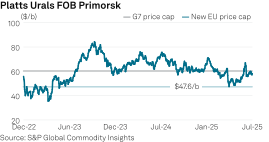
What's happening? Following weeks of negotiations, the UK and EU agreed to lower the price cap on seaborne Russian crude exports to $47.60/b from $60/b. The move came after G7-linked tankers lifted over 39% of Russia's 3.36 million b/d crude exports in June, the highest since the end of 2023, according to S&P Global Commodities at Sea and Maritime Intelligence Risk Suite data. The hike came as Urals, Russia's flagship crude export grade, has been mostly trading below $60/b since late February.
What's next? The sanctions are expected to further escalate Russia's reliance on the shadow fleet, which could lead to increased scrutiny and regulatory measures. Tanker operators in Greece, Europe's top ship-owning nation, are expected to retreat from the restricted market. Industry participants expect tanker rates in Russian trades could rise due to the reduced availability of compliant tankers, with potential ripple effects across global oil markets.
Related factbox: EU approves major overhaul of oil sanctions against Russia
2. SAF demand boosts Asian UCO prices, squeezes UCOME producers
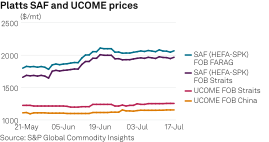
What's happening? The rising demand for sustainable aviation fuel is significantly driving up used cooking oil prices, creating an intense competition in the feedstock market. As SAF producers secure large volumes of UCO, used cooking oil methyl ester producers face increased production costs and low margins. Some plants in Europe and China are operating below capacity or have halted operations due to high feedstock prices and weak UCOME demand.
What's next? The opening of the SAF arbitrage window between China and Europe is expected to sustain high demand for UCO feedstock. Additionally, increased bulk orders from US renewable diesel producers are tightening UCO supplies in domestic markets. High feedstock UCO prices are expected to persist amid high demand and supply constraints.
3. Lithium oversupply concerns linger in Q3
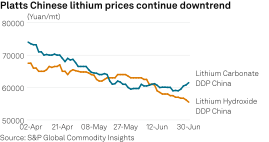
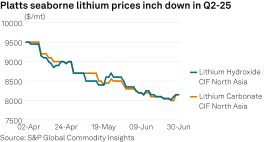
What's happening? Chinese lithium carbonate spot prices recovered to around Yuan 66,000/mt in July 21, after falling to a 4.5-year low of Yuan 59,000/mt late in the second quarter. The rebound followed improved sentiment driven by China's "anti-involution" policy, which aims to reduce unsustainable price competition in the EV sector. Despite positive signals, persistent oversupply and elevated inventories continue to weigh heavily on the market. Some Chinese lithium refiners have suspended operations due to negative margins, and spodumene demand remains subdued amid challenging downstream economics.
What's next? July and August are traditionally off-season months for electric vehicle sales as consumer activity tends to slow during the summer holidays and ahead of new model releases in September, limiting restocking activities. The US' "One Big Beautiful Bill" is influencing lithium buyers in seaborne markets to prioritize cost-competitive raw materials, which is expected to keep seaborne lithium market activity cautious. Given the ample supply of spodumene and the absence of meaningful production cuts, sources said spot lithium prices may face renewed downward pressure as the market moves through the latter part of Q3.
4. Ukrainian wheat exporters shift to Asia, Africa following EU quotas
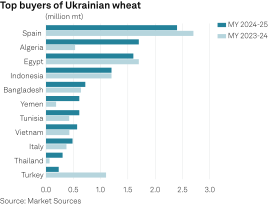
What's happening? Ukrainian sellers are aiming to redirect their wheat exports to Asia and Africa following the reintroduction of import duties and quotas on Ukraine's agricultural products to the EU from June 6. The wheat quota was set at 1.3 million mt, with tariffs of Eur95/mt ($111/mt) for additional imports.
What's next? Traders said that while the EU imported 4.5 million mt of Ukrainian wheat in marketing year 2024-25, with Spain its largest buyer purchasing over 2 million mt, the imposition of the tariffs could undermine Ukraine's competitiveness, creating uncertainty around the volume of future purchases in MY July 2025-June 2026. As Ukraine aims for these markets, there is an acknowledgement, particularly for export to Africa, of the competitiveness of milling wheat exported from Russia to similar destinations, such as Egypt and Turkey.
5. DDGS barge prices climb to 4-week high but market sees limited support ahead
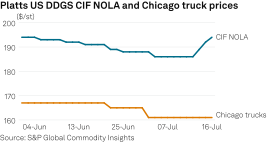
What's happening? The CIF New Orleans dried distillers grains with solubles barge prices climbed $8/st to $192/st week over week of July 14, reaching their highest level in four weeks. This recent surge was driven by short covering and increased trading activity, market sources said, with trades reported in nearby positions. Chicago truck values have remained flat over the same period, with minimal trade and weaker interest compared to the barge market.
What's next? Market participants remain cautious as they anticipate prices could decline when available DDGS supplies are redirected toward river shipments for exports. Sources warn that recent prices are not sustainable as there are indications of weakening demand in the DDGS barge market and increasing concerns about oversupply across markets. Consequently, the outlook reflects a cautious stance due to these shifting supply and demand factors.
Reporting and analysis by Max Lin, Kelly Norways, Litiang Wang, Marco Loke, Chau Kit Boey, Vivian Iroanya, Paola Caballeros
