














































Executive Summary
By providing investors with accessible and innovative tools for income generation, risk management and tactical asset allocation, options-based exchange-traded funds (ETFs) are an increasingly significant part of the investment landscape.
This report focuses on two prominent options-based strategies: covered call and buffered strategies, examining their structures, characteristics and applications via representative indices.
In addition to reviewing the typical designs and features of both types of options strategies, we explore how their use may potentially enhance portfolio resilience, improve performance and risk profiles and provide market participants with tools for navigating market volatility.
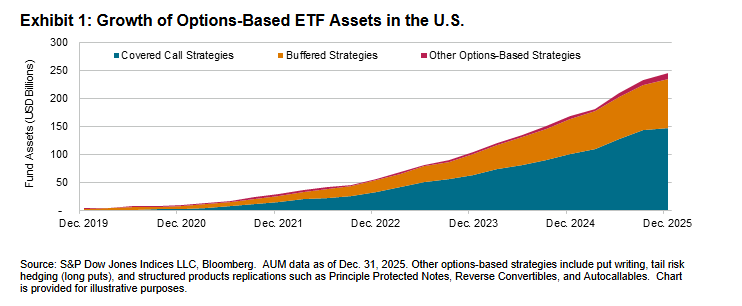
Growth of Options-Based ETFs
Since their initial creation in the early 1990s, ETFs have evolved beyond simple liquid access to broad market indices to encompass a wide range of exposures and applications. More recently, U.S. regulatory changes permitting greater use of derivatives further paved the way for a wide range of options-based ETFs, enabling another evolution.
Market participants have long employed the options markets for income generation, risk management and tactical asset allocation. Options-based ETFs encode these strategies into a single instrument that can—for some investors—prove to be easier to own, more liquid or cheaper than alternatives such as traditional mutual funds, structured products or self-trading. The collective judgement of market participants is visible in the growth of assets under management (AUM) in U.S.-listed options-based ETFs, which grew steadily from less than USD 5 billion at the end of 2019, to USD 245 billion by the end of 2025 (see Exhibit 1).
