












































Executive Summary
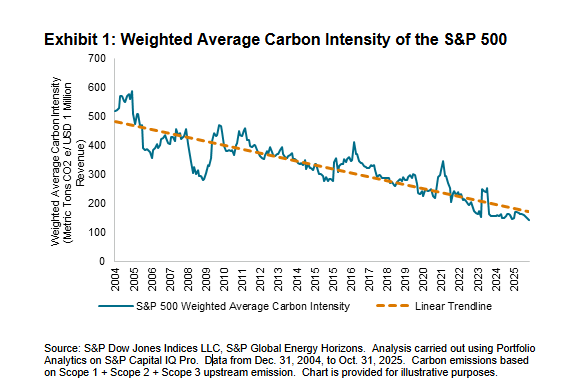
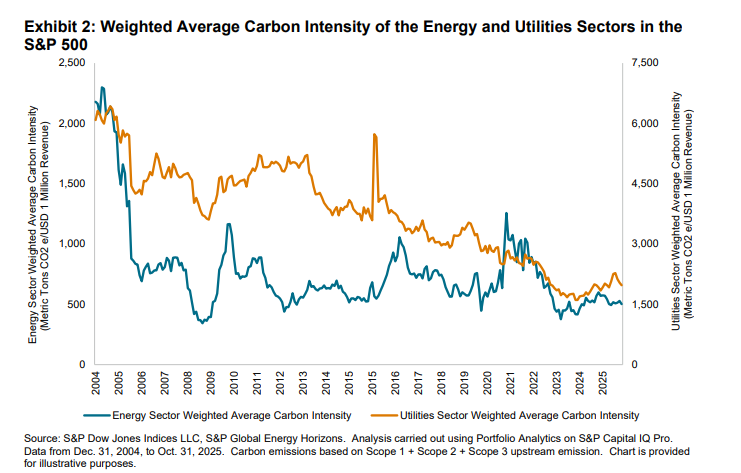
The world is undergoing a shift, evidenced by the S&P 500®’s 72.34% decarbonization over nearly 21 years (see Exhibit 1). This shift is particularly pronounced in traditionally carbon-intensive sectors like Energy and Utilities, which experienced decarbonization rates of 76.97% and 67.52%, respectively (see Exhibit 2). As the energy transition unfolds, market participants face a landscape rich with both risks and opportunities. In this context, indices can serve as useful instruments, offering a wide array of tools across asset classes, including equities, fixed income and commodities. This research paper explores various indices, each highlighting unique aspects of the energy transition and offering insights for effectively navigating this transformative period in the indexing landscape.
The Technological Revolution and Market Forces Driving Energy Transition
The energy transition is enabled by a technological revolution that has brought remarkable efficiencies in the production and consumption of energy. Breakthroughs in renewable energy generation have dramatically decreased the cost of these energy sources, allowing them to compete more effectively with traditional fossil fuels. In particular, solar photovoltaics (PVs), which are the technology that directly converts sunlight into electricity using solar cells, experienced an 86% drop in costs between 2010 and 2023. This decline was accompanied by significant reductions in the costs of both onshore and offshore wind energy. Alongside cost reductions, innovations in energy storage technologies and smart grid advancements have fostered a more decentralized and resilient energy system.
This technological revolution is reinforced by fundamental market forces that continue to accelerate the low-carbon transition. The growing interest of market participants in opportunities related to sustainability—coupled with increasing consumer preference for clean energy—has resulted in a surging demand for renewable energy solutions. Some market participants increasingly recognize the economic benefits tied to investing in renewable technologies, positioning these solutions not solely as ethical initiatives but as viable financial opportunities. Consequently, the renewable revolution appears to be more than just a passing trend; it seems to be evolving into a transformative force that could potentially reshape business models across various sectors.
Indices as Strategic Tools for Market Participants
Indices can play a supportive role in facilitating the energy transition by providing market participants with diverse offerings across various asset classes. They serve as benchmarks to assess performance and mitigate risk, and they enable market participants to identify trends and navigate the complex energy transition landscape. By offering alignment with the associated risks and opportunities of the energy transition, indices can help market participants to assess the potential of this evolving ecosystem.
