











































The S&P 500 Sector Indices dissect the most widely followed U.S. equity gauge—the S&P 500—into its constituent economic engines, using the Global Industry Classification Standard (GICS®) framework.
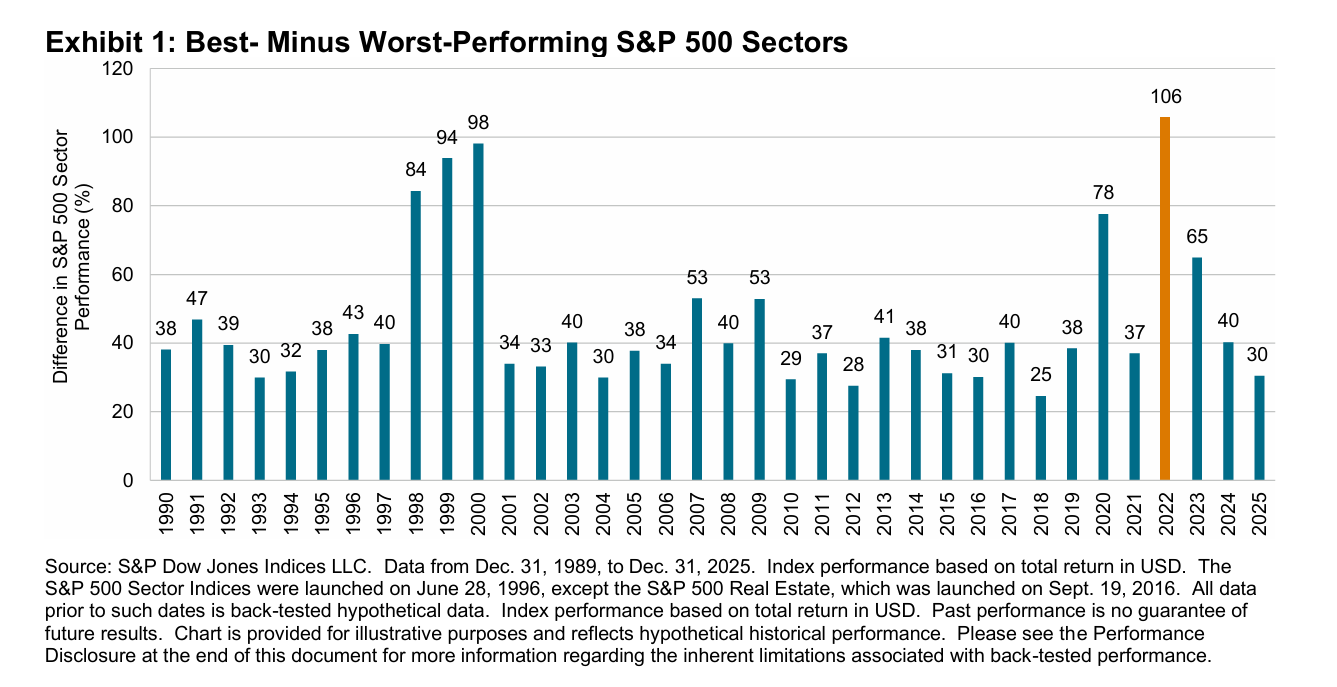
Sector-based perspectives can be valuable for better understanding distinct impacts across market segments and expressing views thereafter. Exhibit 1 shows that the average calendar year difference between the best- and worst-performing S&P 500 sector was 45% between 1989 and 2025.
This paper explains S&P 500 Sector Indices, how they compare with the broader S&P 500 universe, why they may be relevant for market participants and why they may matter as much in Singapore and Tokyo as they do in New York.
Why Sector Indices? The Case for Decomposition
The S&P 500 is one of the most relevant single benchmarks for large-cap U.S. equity performance, yet the S&P 500 alone may not tell the entire story. A market participant who expects AI adoption and digital transformation to accelerate may want to focus more closely on sectors such as Information Technology and Communication Services. Similarly, another who anticipates higher government and infrastructure spending may look toward Industrials. Sector indices make this possible.
More formally, sector indices serve four critical roles in modern markets.
- Benchmarking: Portfolio managers can measure their performance against a specific segment of the economy rather than the entire market. A healthcare-focused fund may use the S&P 500 Health Care instead of the full S&P 500.
- Tactical weighting: Institutional investors may use sector indices to implement views on the business cycle—rotating into cyclicals during expansions and into defensives during slowdowns.
- Risk attribution: Risk managers may decompose portfolio exposures into sector contributions, isolating whether underperformance is driven by security selection or sector misallocation.
- Investable products: Sector indices underpin hundreds of ETFs, futures contracts, options and structured products, creating a liquid and transparent toolkit for implementation.
