












































1. What types of dividend indices exist in the market, and how have market participants historically utilized them?
Dividend indices can generally be categorized into two main types: dividend growth and high yield. Dividend growth indices require that constituents have consistently increased their dividends per share for a minimum number of years. Notable examples include the S&P 500® Dividend Aristocrats® and the S&P U.S. Dividend Growers Index. Market participants often utilize these indices for their historically competitive dividend yields and tendency to track higher-quality companies with robust balance sheets and stable earnings. Conversely, high yield dividend indices prioritize companies that offer the highest dividend yields, often incorporating quality screens. While these indices have tended to reflect higher yields than dividend growth indices, they have also tended to be riskier and may exhibit a stronger value tilt.
Historically, dividend indices have attracted market participants as both long-term strategic building blocks and for short-term tactical uses. Their long-term appeal stems from the combination of income and equity participation, along with liquidity and transparency. Tactically, dividend strategies have often been employed during periods of market uncertainty or rising interest rates, as they have historically tended to outperform in defensive environments.
2. How have dividend indices performed during the tariff-related drawdowns, and how have market participants historically utilized them during periods of market volatility?
During the drawdowns earlier this year, our flagship dividend strategies demonstrated meaningful outperformance compared to their broad market benchmarks. For example, the S&P 500 Dividend Aristocrats outperformed the S&P 500 by 8.16% from the peak on Feb. 19, 2025, to the trough on April 8 (see Exhibit 1).
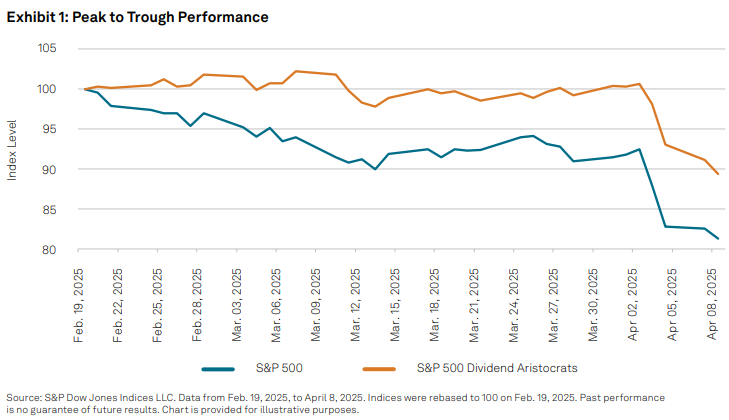
In times of market volatility, market participants often turn to dividend strategies to reduce risk. Dividend growth indices in particular are recognized for their defensive characteristics, as companies that have consistently grown their dividends over extended periods tend to be financially resilient and demonstrate a strong track record across various macroeconomic regimes. Additionally, dividend-paying stocks provide regular income through dividends, which can help cushion losses when price appreciation is uncertain.
Overall, while no strategy is risk free, dividend strategies—especially those focused on dividend growth or incorporating quality screens—have historically provided a degree of stability and predictability. In the past, dividend strategies have shown their ability to preserve capital and maintain income during economic uncertainty or market downturns.
