











































1. What’s driving demand for dividend strategies in an environment of high valuations and geopolitical uncertainty?
In 2026, heightened valuations and ongoing geopolitical uncertainty are pushing investors toward dividend strategies because of their income, diversification and defensive qualities.
With valuation ratios remaining stretched—particularly in technology and growth sectors—dividend strategies offer diversification by focusing more on mature, cash-generative businesses in sectors such as Consumer Staples, Financials and Utilities. Dividend income also serves as an additional source of return beyond capital appreciation. Moreover, these strategies typically target companies with lower valuation multiples, offering an additional layer of comfort for valuation-sensitive investors.
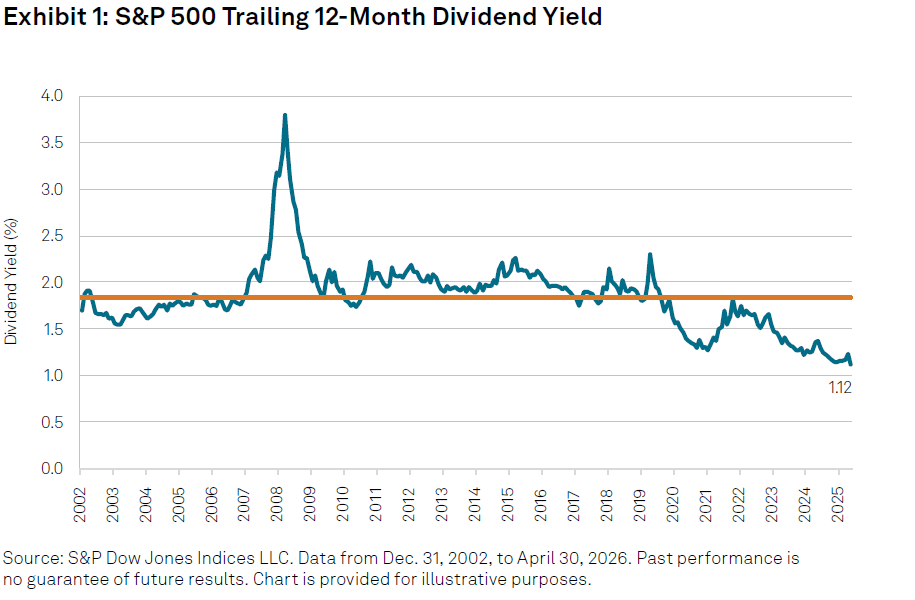
Elevated valuations in the S&P 500® are also exerting downward pressure on its dividend yield. As of April 30, 2026, the S&P 500’s trailing 12-month dividend yield stood at just 1.12%—the lowest level on record since 2002 and significantly below its historical average of 1.83%. With broad equity markets providing minimal yield, dividend-focused strategies are increasingly in demand among investors seeking current income.
Geopolitical risks often lead to greater market volatility and diminished visibility on global growth prospects. In these conditions, companies with stable cash flows and disciplined capital allocation policies stand out. Dividend strategies may naturally tilt toward such firms, which tend to be more resilient during economic shocks and may be better positioned to maintain payouts throughout the cycle.
However, not all dividend strategies are created equal. Methodologies and constituent selection can vary widely, making it crucial to evaluate the approach and its suitability. For example, a high yield strategy that simply selects the highest-yielding companies without applying quality screens may expose investors to greater risks and “yield traps.” Conversely, dividend growth strategies focus on companies with a track record of consistently increasing dividends, rather than just high yields. The S&P 500 Dividend Aristocrats®, for instance, tracks S&P 500 companies that have raised their dollar dividends for at least 25 consecutive years, resulting in a higher quality tilt. Notably, during the Q1 2026 drawdown for the S&P 500, the S&P 500 Dividend Aristocrats outperformed by almost 7%.
2. What has the recent volatility revealed about the defensive characteristics of dividend indices?
Recent market volatility has further underscored the defensive qualities of several dividend indices—especially those with a focus on quality. The dividend income component has provided a stabilizing effect on total returns, acting as a cushion during periods of price decline. Strategies that combine competitive yields with strong balance sheets and consistent earnings have demonstrated greater resilience in market downturns.
For instance, the Dow Jones U.S. Dividend 100 Index adopts a disciplined selection process, targeting companies with above-median yields and then ranking them based on a composite score equally weighted across dividend yield, five-year dividend growth, return on equity (ROE) and free cash flow (FCF) to total debt. Unlike many high yield strategies that use quality screens as an initial filter, this methodology makes quality a primary selection criterion. As a result, the Dow Jones U.S. Dividend 100 Index has delivered strong long-term outperformance, especially during periods of elevated volatility, and has posted robust YTD results through the end of March.
Similarly, the S&P Global Dividend 100 Index applies this methodology globally, focusing on high-quality dividend payers around the world. This index has also demonstrated notable outperformance versus its benchmark during recent volatile market conditions.
