












































Reweighting Companies in the S&P 500 to Enhance Sector Diversification and Reduce Individual Stock Concentration
The S&P 500® remains a trusted benchmark for tracking the performance of U.S. large-cap companies across sectors. As markets evolve, certain stocks and sectors naturally expand to comprise a larger share of the index, reflecting their growing economic influence. Over the past five years, mega-cap stocks have grown to represent a significant portion of the index, with concentration levels in mid-2025 reaching highs not seen in nearly 50 years. At the same time, the Information Technology sector’s weight has approached an all-time peak. While such shifts are a natural outcome of market-cap-weighted indices, they have led some market participants to explore alternative approaches aimed at enhancing diversification.
1. What is the objective of the S&P 500 Diversified Sector Weight Index?
The S&P 500 Diversified Sector Weight Index aims to enhance sector diversification and reduce individual stock concentration. By reweighting companies within The 500™, the index seeks to represent all business activities in the market, not just the largest ones. To achieve a more balanced representation across sectors, the index utilizes a hierarchical equal weight methodology based on Syntax’s FIS® taxonomy.
2. What is Syntax’s FIS taxonomy?
Syntax is a leading technology and financial data company that has developed a proprietary FIS sector taxonomy to organize global publicly listed companies. This taxonomy employs a systematic, data-driven methodology to classify all individual product lines of a company based on actual revenue sources. The FIS taxonomy serves as an alternative to traditional classification frameworks like GICS®, offering a more granular and comprehensive view of a company.
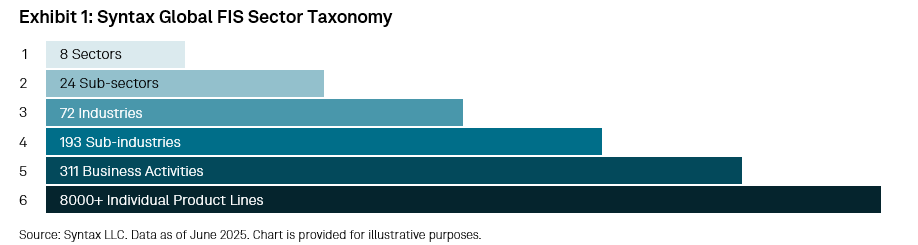
The taxonomy features a multi-layered structure consisting of six layers, starting at the sector level with eight primary sectors and extending down to the product line level. This structure was designed to enhance the diversification of index populations, resulting in more substantial top-level sectors, such as Financials (which includes Banking, Insurance and Real Estate), Energy (which includes Oil & Gas and Utilities) and Industrials (which includes Materials, Components, Equipment and Services).
