











































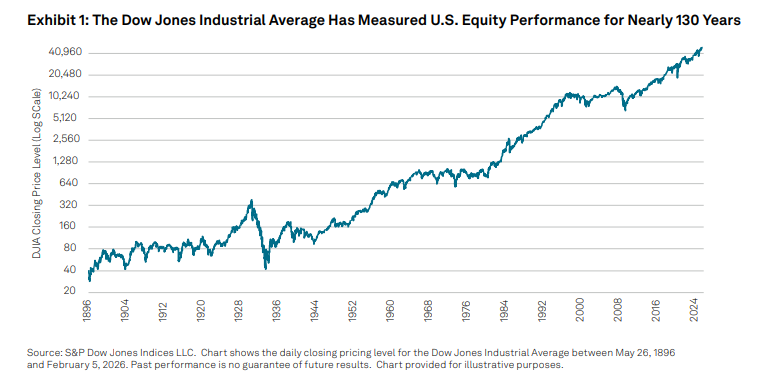
The Dow Jones Industrial Average® (DJIA) closed above the 50,000 point mark for the first time in February 2026, marking another milestone in the index’s near 130-year history. While such thresholds are often viewed as symbolic, the move highlights the continued relevance of one of the world’s longest-running equity benchmarks in tracking shifts in the U.S. market.
Hamish Preston, Head of U.S. Equities at S&P Dow Jones Indices, discusses what the latest milestone reveals about The Dow’s resilience, how the index has evolved through constituent changes and shifting sector dynamics, and the role it continues to play in reflecting the development of the U.S. economy.
He also explains how The Dow’s construction shapes its sector exposure today, addresses common misconceptions around its relevance and outlines why it remains a useful reference point for global investors despite the availability of broader U.S. equity benchmarks.
1. What does The Dow® closing above 50,000 for the first time (in February) highlight about the index’s role and resilience over its 130-year history?
The Dow closed above 50,000 for the first time in its near 130-year history on Feb. 6, 2026. This milestone marked the third time this decade that the U.S. equity barometer first surpassed a 10,000 increment and—unsurprisingly, perhaps, given successive milestones require smaller gains to be achieved—the latest milestone came in record time, less than two years after it first closed above 40,000.
While some may question the significance, psychological or otherwise, of market barometers hitting certain thresholds, The Dow’s milestones illustrate how the index provides market participants with a way to measure the U.S. equity market and understand the trends that have impacted the segment over the past 130 years.
2. How has The Dow evolved over time?
Launched on May 26, 1896, The Dow was born out of Charles Dow’s hunch at the end of the 19th century that industrial companies would be crucial contributors to U.S. economic growth. Charles Dow’s hunch proved correct: various manufacturers were added to The Dow in the 20th century to reflect the prominence of these companies in the U.S. equity market at the time.
Importantly, The Dow resonates around the world because it has continued to evolve to reflect key trends in the U.S. equity market. Indeed, there have been 136 constituent changes to The Dow since May 1896, with more recent constituent changes—including the latest updates—ensuring the DJIA reflects the growing importance of other segments.
These changes have impacted the average tenure of The Dow’s constituents over time. The Dow’s expansion from 12 stocks to 20 stocks in 1916, and its further expansion to the now familiar 30-stock count in 1928, contributed to notable declines in the average tenure in the first few decades. A prolonged period of relatively few constituent changes then saw the average tenure reach 48 years in the mid-1980s, before declining in recent decades; the average tenure was around 25 years at the end of January 2026.
Additionally, the way in which The Dow is used has continued to evolve. Beyond its role as a barometer for US equity performance, the index has also come to serve as the underlying benchmark for various index-linked products around the world in recent decades, with an estimated USD 115 billion indexed or benchmarked to The Dow at the end of 2024. The Dow also has a robust trading ecosystem, promoting price transparency and market efficiency, with more than USD 8 trillion in index equivalent trading volume (IET) in products linked to the index in 2024.
