












































Introduction
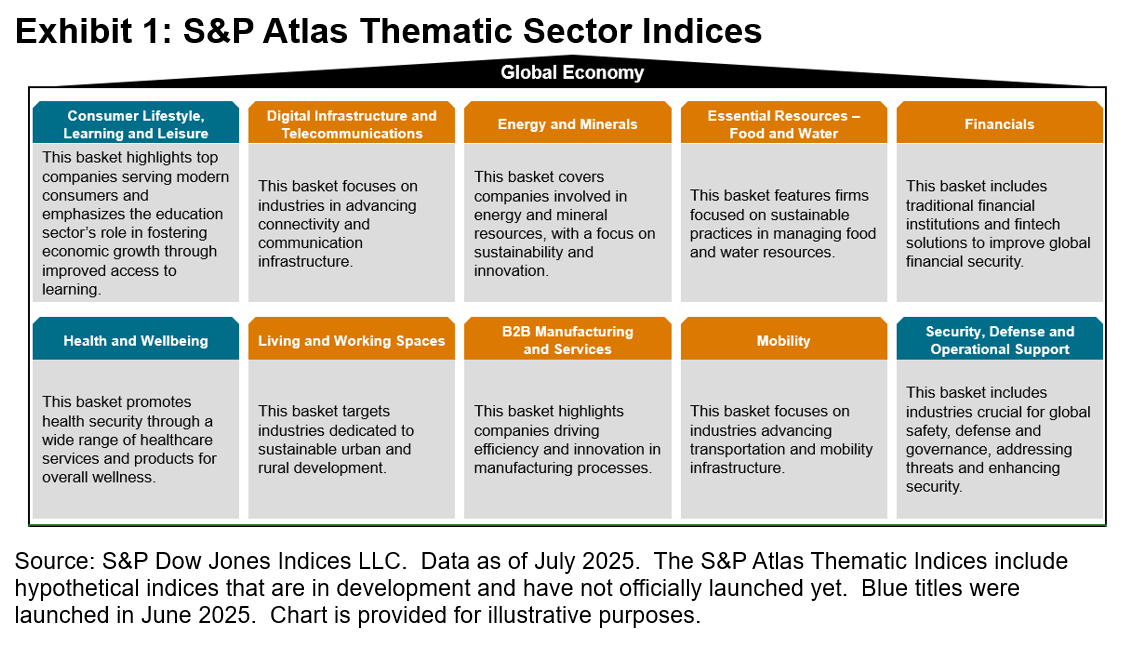
S&P Dow Jones Indices (S&P DJI) recently launched the S&P Atlas Thematic Indices, a new suite of indices spotlighting 10 of the core themes that drive today’s—and tomorrow’s—global economy.
The S&P Atlas Thematic Sectors resemble familiar sector groupings (for example, Financials is similar to the GICS® Financials sector and Health and Wellbeing is similar to the GICS Health Care sector), while also embracing cross-sector areas like Security, Defense and Operational Support, as well as Mobility. Each of the 10 S&P Atlas Thematic Sectors is represented by an index that includes both established market leaders and emerging innovators driving the future of that theme (see Exhibit 1).
Redrawing the Map
Thematic indexing has grown significantly over the past five years, with assets under management (AUM) doubling from USD 269 billion to an estimated USD 562 billion globally by the end of 2024. Despite this expansion, thematic portfolios remain underutilized in broader allocations. Even with the notable increase in demand for thematic products in early 2021, the largest thematic exchange-traded funds (ETFs) hovered around USD 9 billion in AUM—far below the USD 58 billion range of the largest sector ETFs. While sector ETFs can also be viewed as thematic—representing broad, globally significant themes—their AUM is typically several times larger than their traditional thematic counterparts. This gap in adoption can be attributed to several factors, with two playing particularly influential roles.
- Themes: Many popular thematic strategies by AUM often center on emerging and potentially disruptive areas such as Clean Energy, AI or Cloud Computing. These forward-looking themes offer meaningful growth potential, though their early-stage development tends to limit the scale of asset accumulation at this point.
- Portfolio Location: Thematic products typically occupy the satellite portion of portfolios, rather than the core. Core strategies are designed to reflect the broader economy and established technologies, while the satellite sleeve is generally reserved for emerging or disruptive themes whose long-term significance is still being assessed. Since most capital is concentrated in core holdings, thematic strategies—by virtue of their placement in the satellite bucket—naturally tend to receive smaller allocations compared to broad-market or sector-based products.
Traditional classification systems (like GICS) largely guide core allocations by reflecting the current structure of the economy. In contrast, thematic portfolios—typically placed in the satellite segment—aim to reflect emerging technologies that could define the future economy.
Managing exposure across both established and disruptive innovations using a two-tiered approach may create ongoing demands on portfolio management. It requires significant time and resources to regularly identify new emerging trends and to adjust how capital is divided between the core and satellite parts of the portfolio, based on market conditions and the maturity of each investment theme.
We propose a unified approach that bridges the gap between today’s and tomorrow’s markets by viewing the global economy through a thematic lens. This approach centers on 10 foundational S&P Atlas Thematic Sectors that are structurally embedded in the global economy and remain consistently relevant over time.
