













































Summary
The S&P 500® rose by 10% in the first six months of 2026, rebounding sharply in Q2 after a dismal Q1. Robust corporate earnings and an expansion in market breadth were accompanied by the outperformance of mid and small caps, with the S&P MidCap 400® and the S&P SmallCap 600® up 17& and 24%, respectively. Compared with recent years, active managers faced a more supportive market backdrop, characterized by broader participation and stronger performance outside the largest stocks.
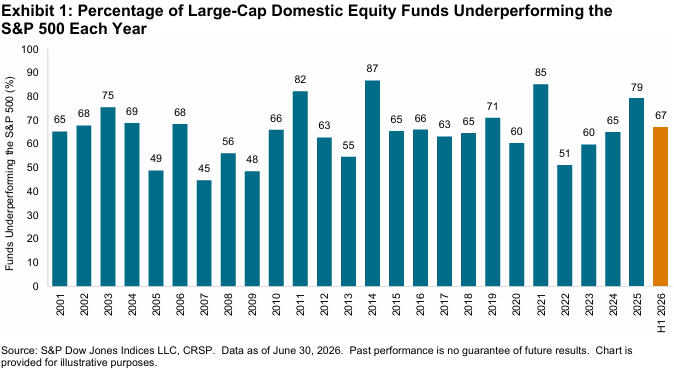
In our largest and most closely watched comparison, 67% of all active large-cap U.S. equity funds underperformed the S&P 500. It was an improvement from the 79% rate observed over full-year 2025, but these seemingly favorable conditions were still not enough for most managers to capitalize on.
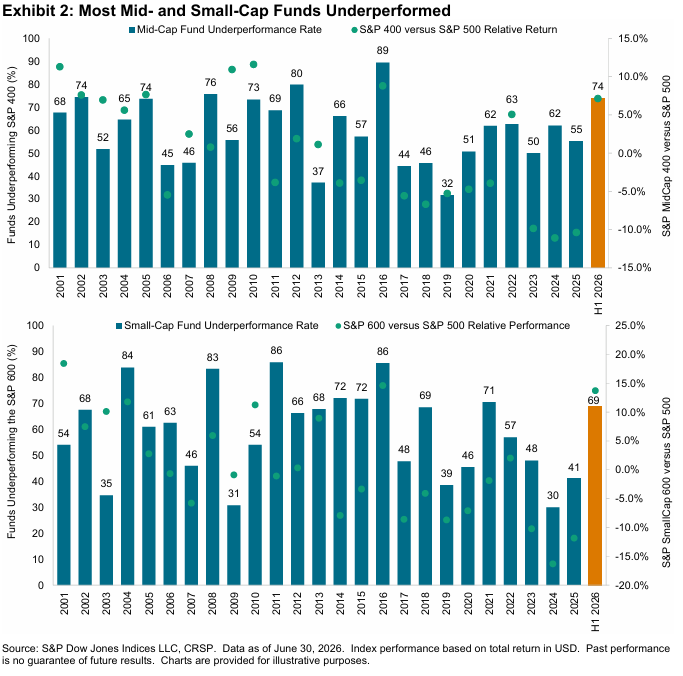
In a marked turning point from the prior three years, the S&P 400® and the S&P 600® outperformed The 500® by 7% and 14%, respectively, in H1 2026. This may have created opportunities for large-cap managers to tilt toward outperforming smaller caps to generate greater relative outperformance, but fewer opportunities for mid- and small-cap managers to tilt toward the larger end of the capitalization range. 74% of All Mid-Cap funds and 69% of All Small-Cap funds underperformed.
Fortunes favored managers focused on international equities, as evidenced by only 49% of U.S.-domiciled International funds and 53% of Global funds underperforming their respective benchmarks. Managers that were overweight in outperforming emerging markets could have benefited, with the S&P Emerging Plus Index up 22%, beating both the S&P World Index and the S&P World Ex-U.S. Index by 13%. Notably, emerging market managers fared even better than their international peers: only 38% of Emerging Markets funds underperformed the S&P Emerging Plus Index.
Unlike in 2025, international small-cap managers generally performed better than their emerging market peers: only 35% of International Small-Cap funds underperformed the S&P Developed Ex-U.S. Small-Cap. The benchmark was the laggard among our reported equity category benchmarks, up 6% in H1 2026, underperforming the S&P World Ex-U.S. by 4%. A lower hurdle to beat combined with plentiful opportunities to tilt toward international mid and large caps were favorable tailwinds.
Results for bond managers were generally better, with a cross-category average underperformance rate of 38%, lower than the 60% observed across equities. Only 42% of General Investment Grade and 49% of High Yield funds underperformed their respective benchmarks. Performance for government managers was bleak: 77% of General Government funds underperformed.
