












































Since the first publication of the S&P Indices Versus Active (SPIVA) U.S. Scorecard in 2002, S&P Dow Jones Indices has been the de facto scorekeeper of the ongoing active versus passive debate. The SPIVA New Zealand Scorecard measures the performance of actively managed funds offered in New Zealand against benchmarks over various time horizons, covering both equity and bond funds.
Mid-Year 2026 Highlights
The first half of 2026 proved challenging for active funds in New Zealand. A majority underperformed their assigned benchmarks in most reported categories, with particularly high underperformance rates among domestic equity and bond funds. Global Equity (Hedged) delivered the strongest relative results, although half of funds still failed to beat the benchmark. While short term outcomes varied, a majority of active funds in each category underperformed over 10- and 15 year horizons.
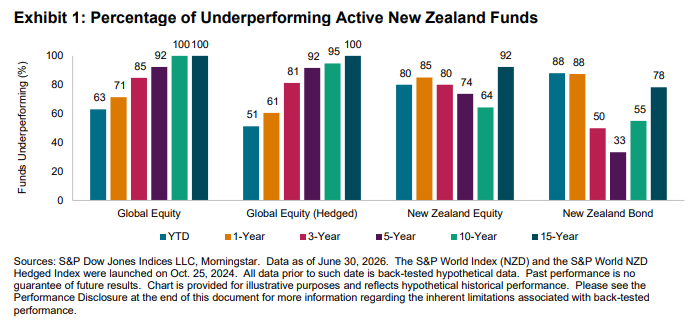
- Global Equity Funds: Global equities delivered solid gains during the first half of 2026. The S&P World Index rose 10.6%, while the average actively managed Global Equity fund returned 8.9% on an equal-weighted basis and 8.7% on an asset-weighted basis. Consequently, 63% of funds underperformed the benchmark. Long-term results remained unfavorable, with all funds underperforming over the 10- and 15-year horizons.
- Global Equity (Hedged) Funds: Currency-hedged global equity funds recorded the lowest underperformance rate among the reported categories, at 51% in H1 2026. The average actively managed Global Equity (Hedged) fund returned 7.0% on an equal-weighted basis and 8.4% on an asset-weighted basis, compared with a 9.1% gain for the S&P World NZD Hedged Index. Underperformance rates rose sharply over longer horizons, reaching 95% over 10 years and 100% over 15 years.
- New Zealand Equity Funds: The S&P/NZX 50 Index gained 0.5% (0.8% with imputation credits), while the average actively managed New Zealand Equity fund declined 0.7% on an equal-weighted basis and 0.5% on an asset-weighted basis. As a result, 80% of funds underperformed the benchmark. Although the underperformance rate was lower over the 10-year horizon, 64% of funds still failed to beat the benchmark, while more than 90% underperformed over 15 years.
- New Zealand Bond Funds: The S&P/NZX Composite Investment Grade Bond Index gained 2.4%, while the average New Zealand Bond fund returned 1.9% on an equal-weighted basis and 2.1% on an asset-weighted basis. Consequently, 88% of funds underperformed during the first half of 2026. This result represented a marked deterioration relative to recent years, although longer-term outcomes remained comparatively better than those seen in the equity categories, with 55% and 78% of funds underperforming over the 10- and 15-year horizons, respectively.
- Fund Survivorship: Fund survivorship remained exceptionally high during the first half of 2026. All 130 funds across the reported categories survived through June 30, 2026 (see Report 2). However, survivorship declined substantially over longer horizons. After 15 years, fewer than half of all funds remained in operation, highlighting the importance of accounting for fund closures when evaluating long-term fund performance.
Market Context
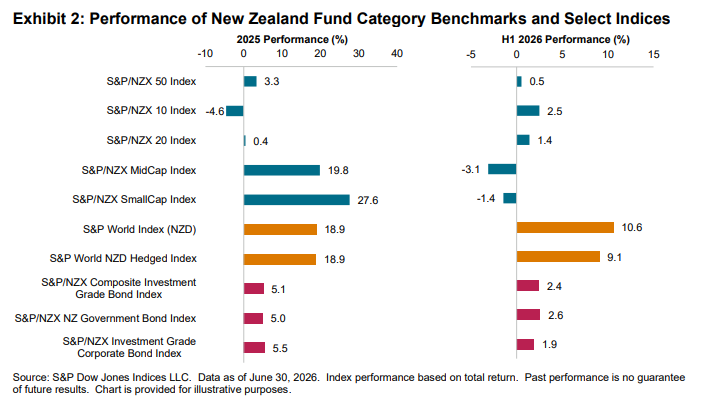
New Zealand equities continued to lag global peers during the first half of 2026. The S&P/NZX 50 Index gained only 0.5%, or 0.8% with imputation credits, considerably below the 10.6% performance from the S&P World (NZD). Within New Zealand equities, market leadership shifted back toward larger companies. The S&P/NZX 10 Index rose 2.5%, while the S&P/NZX MidCap Index and S&P/NZX SmallCap Index declined 3.1% and 1.4%, respectively, following double-digit gains in 2025. Meanwhile, fixed income markets were positive, with the S&P/NZX Composite Investment Grade Bond Index advancing 2.4% (see Exhibit 2).