









































The SPIVA Australia Scorecard measures the performance of actively managed funds relative to benchmarks over various time horizons, encompassing equity, real estate and bond funds, while providing statistics on outperformance rates, survivorship rates and fund performance dispersion.
Mid-Year 2026 Highlights
The first half of 2026 proved challenging for active managers across Australian equity categories. A majority of funds underperformed their respective benchmarks in every reported equity category. By contrast, Australian Bonds was the only category in which a slim majority of active funds outperformed the benchmark. Over longer horizons, active funds continued to face considerable headwinds, with underperformance remaining elevated across all categories.
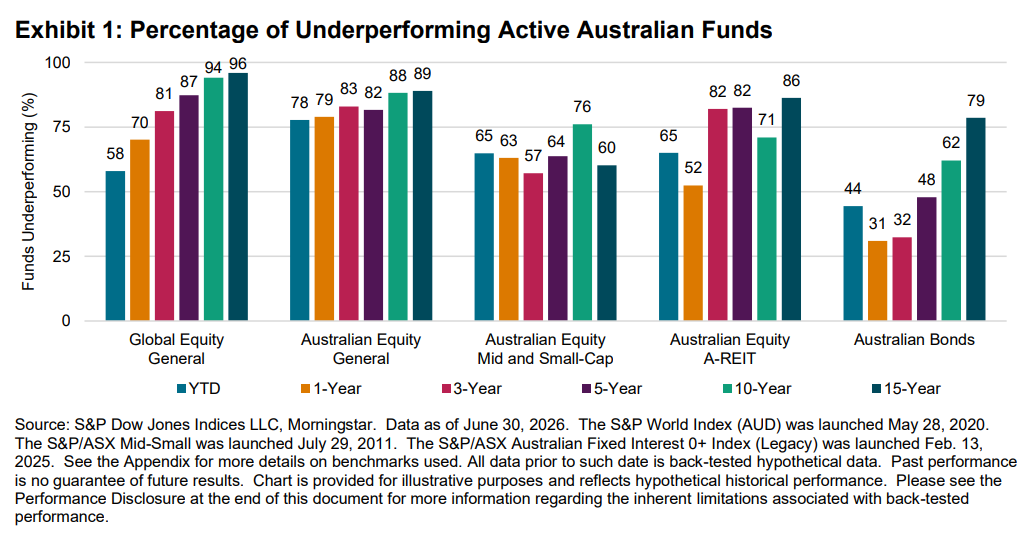
- Global Equity General Funds: Global equities posted moderate gains in the first half of 2026, with the S&P World Index advancing 5.3%. Actively managed Global Equity General funds struggled to keep pace with the broad market, delivering an average return of 2.7% on an equal-weighted basis and 3.0% on an asset-weighted basis, with 58% of funds underperforming. Underperformance rates increased substantially over longer horizons, reaching 94% over 10 years and 96% over 15 years.
- Australian Equity General Funds: The S&P/ASX 200 gained 2.4% in H1 2026, while the average actively managed Australian Equity General fund returned only 0.2% on an equal-weighted basis and 4% on an asset-weighted basis. Three out of four funds (78%) failed to beat the benchmark, putting 2026 on track to record the second-highest underperformance rate since 2013 (see Exhibit 7). Over the 15-year period, 89% of funds underperformed.
- Australian Equity Mid- and Small-Cap Funds: Smaller Australian companies lagged their large-cap counterparts in H1 2026. The S&P/ASX Mid-Small declined 5.9%, while the average Australian Equity Mid- and Small-Cap fund returned -7.6% on an equal-weighted basis and -8.7% on an asset-weighted basis. Consequently, 65% of funds underperformed the benchmark. Although long-term outcomes remained challenging, with underperformance rates rising to 76% over 10 years, this category continued to fare somewhat better than Australian Equity General funds.
- Australian Equity A-REIT Funds: Listed property securities also struggled during the first half of 2026. The S&P/ASX 200 A-REIT fell 5.2%, while the average Australian Equity A-REIT fund declined 5.6% on both equal-weighted and asset-weighted bases. As a result, 65% of funds underperformed the benchmark. Underperformance rates remained elevated over longer horizons, reaching 71% over 10 years and 86% over 15 years.
- Australian Bonds Funds: The S&P/ASX iBoxx Australian Fixed Interest 0+ Index (Legacy) gained 2.3% in H1 2026, while active Australian Bonds funds slightly exceeded benchmark performance on average, generating returns of 4% on both equal-weighted and asset-weighted bases. Nevertheless, 44% of funds underperformed the benchmark, up from 27% in calendar year 2025 (see Report 1c). Long-term results remained challenging, with underperformance rates reaching 62% and 79% over the 10- and 15-year horizons, respectively.
- Fund Survivorship: Fund liquidation remained moderate during the first half of 2026, averaging 3% across all categories. Australian Equity A-REIT funds experienced the highest liquidation rate, at 8%. Survivorship declined significantly over longer horizons; after 15 years, more than one-half of funds had either merged or liquidated, highlighting fund closures as an additional risk for fund selectors.
