










































Introduction
North American institutions have been integrating exchange-traded funds (ETFs) into their portfolios for more than a decade. Many institutions in the U.S. and Canada started employing ETFs to execute tactical tasks within their portfolios. As they began experimenting, they viewed ETFs’ liquidity and ability to rapidly access exposures as useful tools in functions like manager transitions, portfolio completion, and liquidity management. As institutions increased their usage of ETFs in these short-term functions, many observed their versatility and began using them across a broader range of applications.
Institutions gradually embraced ETFs as a tool for portfolio management in step with another trend in investing: the rise of passive strategies. As institutions shifted assets from active to passive strategies in large-cap equities and other highly liquid and increasingly commoditized asset classes, they noted that ETFs could work well as a vehicle for taking on long-term strategic exposures. Today, most ETFs in institutional portfolios are passive and categorized as strategic assets, as opposed to tactical.
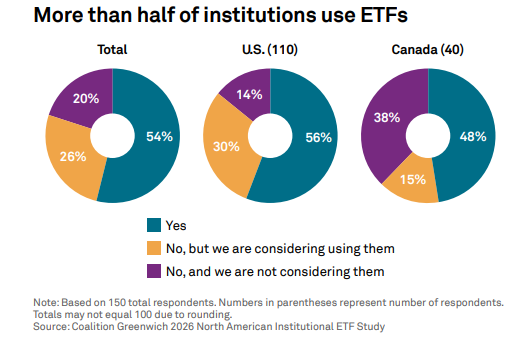
The ability for institutions to use ETFs as both a tool for tactical portfolio functions and as a means of taking on long-term strategic exposures is leading to increased adoption and expanding allocations. ETF assets under management (AUM) have doubled in institutional portfolios in past years.1 More than a third of institutions have reported plans to increase allocations to ETFs in the next 12 months. Meanwhile, more than half of institutional non-users have indicated they are actively considering introducing ETFs into their portfolios.
In an effort to learn how institutions are using ETFs, S&P Dow Jones Indices engaged Crisil Coalition Greenwich to interview 150 institutions in the U.S. and Canada. Participants were asked about current allocations and applications, reasons for use, obstacles to ETF investment, expected changes to use and allocation, and other topics. In this report, Crisil Coalition Greenwich draws on the results of that research to present a detailed breakdown of the state of ETF investment in institutional portfolios. S&P Dow Jones Indices has sponsored this report.
ETFs: A growing presence in institutional portfolios
Across North America, more than half (54%) of institutions now employ ETFs in their investment portfolios. Usage rates are highest in the U.S., where 56% of institutions employ ETFs.
The largest institutions in North America by AUM are the heaviest users of ETFs. Over half of funds with $1 billion - $10 billion AUM and nearly two-thirds of funds with $10 billion+ AUM use ETFs.
