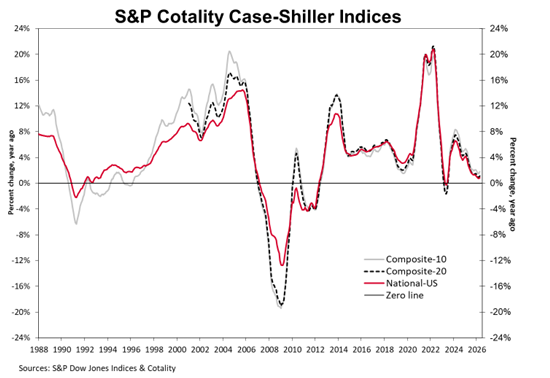










































- The S&P Cotality Case-Shiller U.S. National Home Price NSA Index posted a 0.8% annual gain for April 2026, up from a 0.7% rise in the previous month.
- For the 11th consecutive month, U.S. home values fell in real terms, as April’s 3.8% inflation ran roughly 3 percentage points above the 0.8% home price gain.
- A nearly 9 percentage-point gap separated April’s strongest market (Chicago +6.5% YoY) and its weakest (Seattle -2.3%), underscoring a stark regional divergence in home price trends.
NEW YORK, JUNE 30, 2026: S&P Dow Jones Indices (S&P DJI) today released the March 2026 results for the S&P Cotality Case-Shiller Indices.
More than 27 years of history are available for the data series and can be accessed in full by going to www.spglobal.com/spdji/en/index-family/indicators/sp-Cotality-case-shiller.
Cotality continues to have transaction delays from the recording office in Wayne County, the most populous county in the Detroit metro area. These delays impacted the April transaction data and, therefore, no valid April 2026 update of the Detroit S&P Cotality Case-Shiller Index will be provided for the June 30, 2026, release date. There was, however, enough data to calculate a valid March 2026 update, which is provided in Tables 2 and 3.
S&P DJI will continue to provide updates to the Detroit index values for the month(s) with missing sale transactions data.
ANALYSIS
"April's figures confirm that U.S. home prices remain essentially flat, with the S&P Cotality Case-Shiller National Home Price Index up a scant 0.8% year over year, just above March's 0.7% pace," said Nicholas Godec, CFA, CAIA, CIPM, Head of Fixed Income Tradables & Commodities at S&P Dow Jones Indices. "With inflation accelerating to 3.8% in April, U.S. home values have now declined in real terms for an 11th straight month, further eroding inflation-adjusted housing wealth.
"Geographic dispersion remains pronounced," Godec continued. "Midwest and Northeast markets are still leading moderate growth, while many Sun Belt and Western metros see ongoing declines. Chicago was again the strongest market with a 6.5% annual gain, trailed by New York (3.8%) and Cleveland (3.2%). Seattle’s 2.3% year-over-year drop was the steepest in April, with Denver (-1.8%), Tampa (-1.8%), Dallas (-1.6%), and Phoenix (-1.7%) also among the notable decliners. The nearly 9 percent performance spread between Chicago and Seattle highlights how localized housing trends remain.
"Monthly price movements show seasonal strength masking underlying softness," Godec observed. "On a non-seasonally adjusted basis, the National Index rose 0.8% from March (with the 10-City and 20-City Composites up 1.1% and 1.0%, respectively), reflecting typical spring gains. Yet after seasonal adjustment, the National Index dipped 0.1%, while the 20-City Composite was essentially flat (-0.04%). The latest six months saw a 1.35% national increase, offsetting a -0.5% decline in the prior six months. This represents a modest shift in direction, but remains limited in the context of rising costs.
"The affordability pinch remains a key headwind," Godec concluded. "After dipping below 6% earlier this year, 30-year mortgage rates climbed back to 6.3% in April, keeping financing costs elevated. In this higher-rate environment, home price growth remains constrained, with housing largely treading water in nominal terms and falling in real terms."
YEAR-OVER-YEAR
The S&P Cotality Case-Shiller U.S. National Home Price NSA Index, covering all nine U.S. census divisions, reported a 0.8% annual gain for April. The 10-City Composite saw an annual increase of 1.8%, up from a 1.5% increase in the previous month. The 20-City Composite posted a year-over-year increase of 1.1%, up from a 0.9% rise in the previous month.
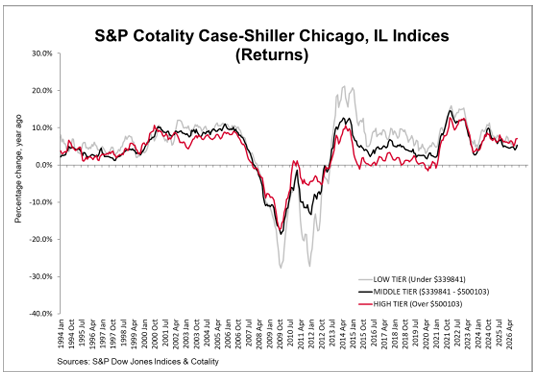
Chicago reported the highest annual gain among the 20 cities with a 6.5% increase in April, followed by New York and Cleveland with annual increases of 3.8% and 3.2%, respectively. Seattle posted the lowest return in April, falling 2.3%.
MONTH-OVER-MONTH
The pre-seasonally adjusted U.S. National, 10-City Composite, and 20-City Composite Indices recorded monthly gains of 0.8%, 1.1%, and 1.0%, respectively.
After seasonal adjustment, the U.S. National and 20-City Composite Indices reported monthly decreases of 0.1% and 0.04%, while the 10-City Composite Index posted a 0.04% gain.
SUPPORTING DATA
The S&P Cotality Case-Shiller U.S. National Home Price NSA Index, which covers all nine U.S. census divisions, recorded a 0.8% annual increase in April 2026. The 10-City and 20-City Composites reported year-over-year increases of 1.8% and 1.1%, respectively. The chart below depicts the annual returns of the U.S. National, 10-City Composite, and 20-City Composite Home Price Indices.