










































The S&P China A-Share LargeCap Low Volatility High Dividend 50 Index seeks to measure the performance of the 50 least volatile, high-dividend-yielding, large-cap stocks in the China A-shares market. Low volatility and dividends are factors that have delivered risk premium in the China A-share market in the past.
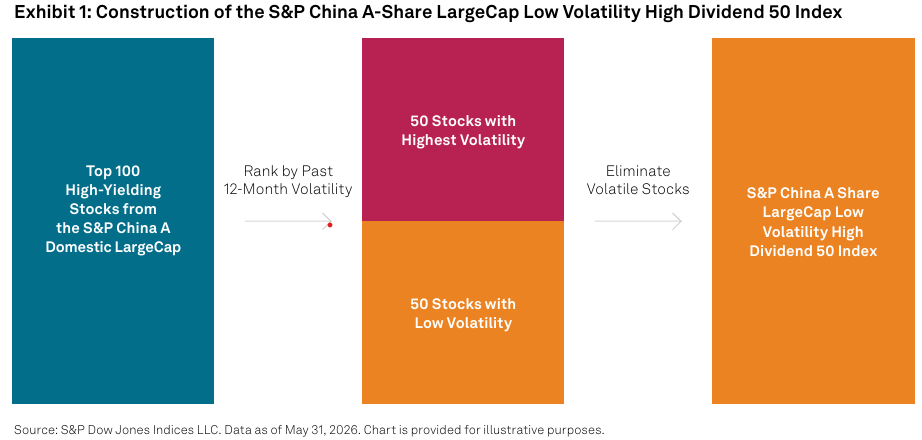
The index combines the two factors through sequential dividend and low volatility screens. Companies exhibiting high dividend yield may fall in a “dividend trap,” since high dividend yield can be caused by decreasing stock prices rather than increasing dividend payments. Overlaying a low volatility screen on a high dividend strategy has historically helped to eliminate the dividend trap, resulting in improved absolute and risk-adjusted performance.
Since launch, the S&P China A-Share LargeCap Low Volatility High Dividend 50 Index has shown higher performance, lower risk, reduced drawdown and cheaper valuation than its benchmark, the S&P China A Domestic LargeCap.
Uncertainty has been a common theme for the Chinese equity market since 2021, amid worries over economic slowdown. The S&P China A-Share LargeCap Low Volatility High Dividend 50 Index may help to provide a defensive and resilient solution to navigate challenging periods.
1. How does the index work?
The S&P China A-Share LargeCap Low Volatility High Dividend 50 Index is designed to measure large-cap companies with and high dividend yield while limiting volatility. Index construction starts from the S&P China A Domestic LargeCap, which consists of the top 70% of stocks by float market capitalization in the China A market. As of May 31, 2026, the S&P China A Domestic LargeCap had 571 constituents. First, the top 100 stocks with the highest yields are selected. After that, volatility screening is applied to eliminate the 50 most volatile stocks. The remaining 50 names are weighted by dividend yield. The index rebalances semiannually in January and July.