











































Introduction
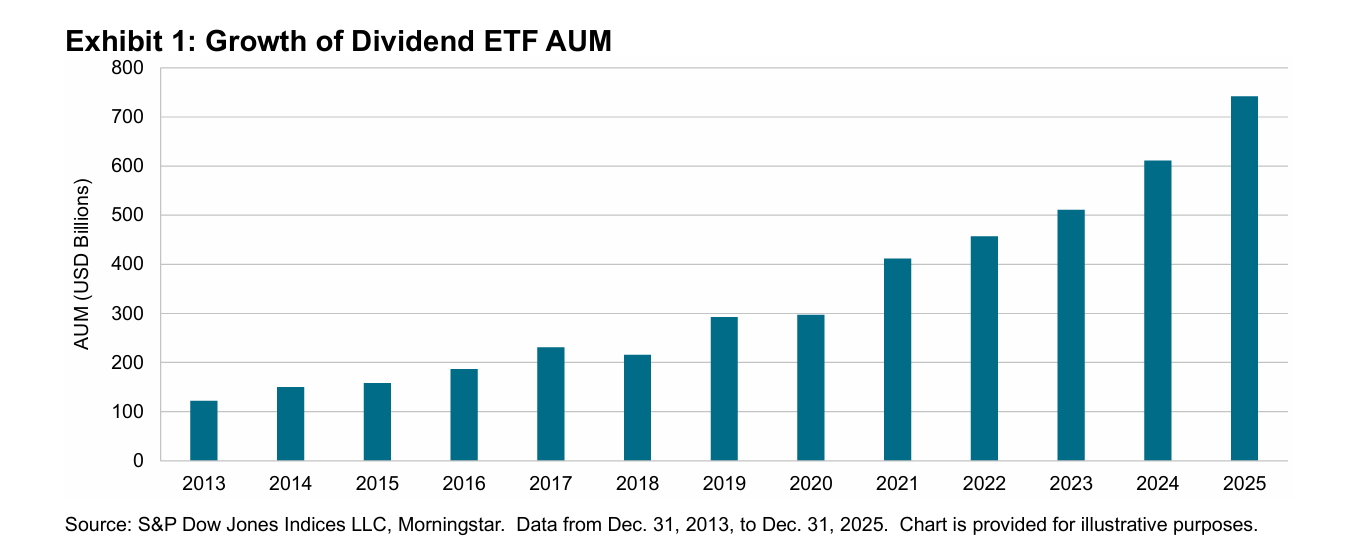
Dividend strategies have been getting strong market attention globally; over the past 10 years, the assets under management (AUM) of ETFs that track dividend indices have increased substantially. As of May 29, 2026, they sat at more than USD 700 billion (see Exhibit 1).
This interest, however, is not a recent phenomenon. The first generation of dividend ETFs was launched in 2003, including one tracking the Dow Jones U.S. Select Dividend Index. Over the past two decades, dividend ETFs have gained broad global adoption, expanding beyond the U.S. market into regions such as Asia Pacific, Europe, the Middle East and Africa.
Market participants often pay attention to dividend strategies because of their features designed for potential income generation, which could provide cash flow. This would be an equity option for potential income generation in addition to some of the traditional fixed income instruments. We have also seen in some markets that dividend income strategies have historically outperformed the broad-based market benchmark.
Dogs of the Dow
The origins of systematic dividend strategies can be traced back to simple, rules-based approaches such as the “Dogs of the Dow,” a well-known strategy popularized by Michael O’Higgins and John Downes in the early 1990s. The strategy selects the 10 stocks in the Dow Jones Industrial Average® (DJIA) with the highest dividend yields and rebalances the basket annually. O’Higgins showed that, from 1973 to 1998, a basket of the 10 highest-yielding DJIA constituents had an annualized performance of 17.9%, compared with 13.0% for the DJIA over the same period.
While the Dogs of the Dow remains a well-established dividend strategy, its traditional construction leaves room for methodological innovation. A typical Dogs of the Dow approach relies on trailing 12-month dividend yield, calculated by dividing dividends paid over the prior year by the stock price on a specified reference date, such as Dec. 31. One key aspect of this approach is that it is inherently backward-looking: it reflects dividends that have already been paid, rather than the market’s expectation of future dividend income. This raises an important question: can the Dogs of the Dow framework be adapted using a more forward-looking measure of dividend yield?
S&P Dow Jones Indices, using data from S&P Global Market Intelligence, has developed a modern version of this classic strategy: the Dow Jones U.S. High Dividend 10 Index. The index measures the performance of the 10 stocks in the DJIA with the highest forecast dividend yields, offering a forward-looking approach to identifying potential dividend opportunities within one of the most widely followed U.S. equity benchmarks.
