











































The municipal bond market was one of the brightest spots in fixed income during the first half of 2026. Record issuance was met with steady retail inflows and strong demand from ETFs and active managers, while credit fundamentals remained healthy. The municipal bond market experienced high issuance volumes over the past 18 months, with USD 587 billion issued in 2025 and USD 299 billion issued YTD through June 30, 2026, a 5% increase compared to the same period last year.
A notable trend has been the growth of prepaid gas bond issuance, which has climbed sharply since 2016, reaching USD 31 billion in 2025. Momentum continued in 2026, with over USD 24 billion issued YTD through June 30, 2026, an increase of 132%. Alphabet, Google’s parent company, was involved in a first-of-its-kind prepaid energy deal estimated at USD 1.2 billion.2 Alphabet’s entry into this market reflects the growing use of prepaid energy agreements by hyperscalers to secure power for the AI data center boom.
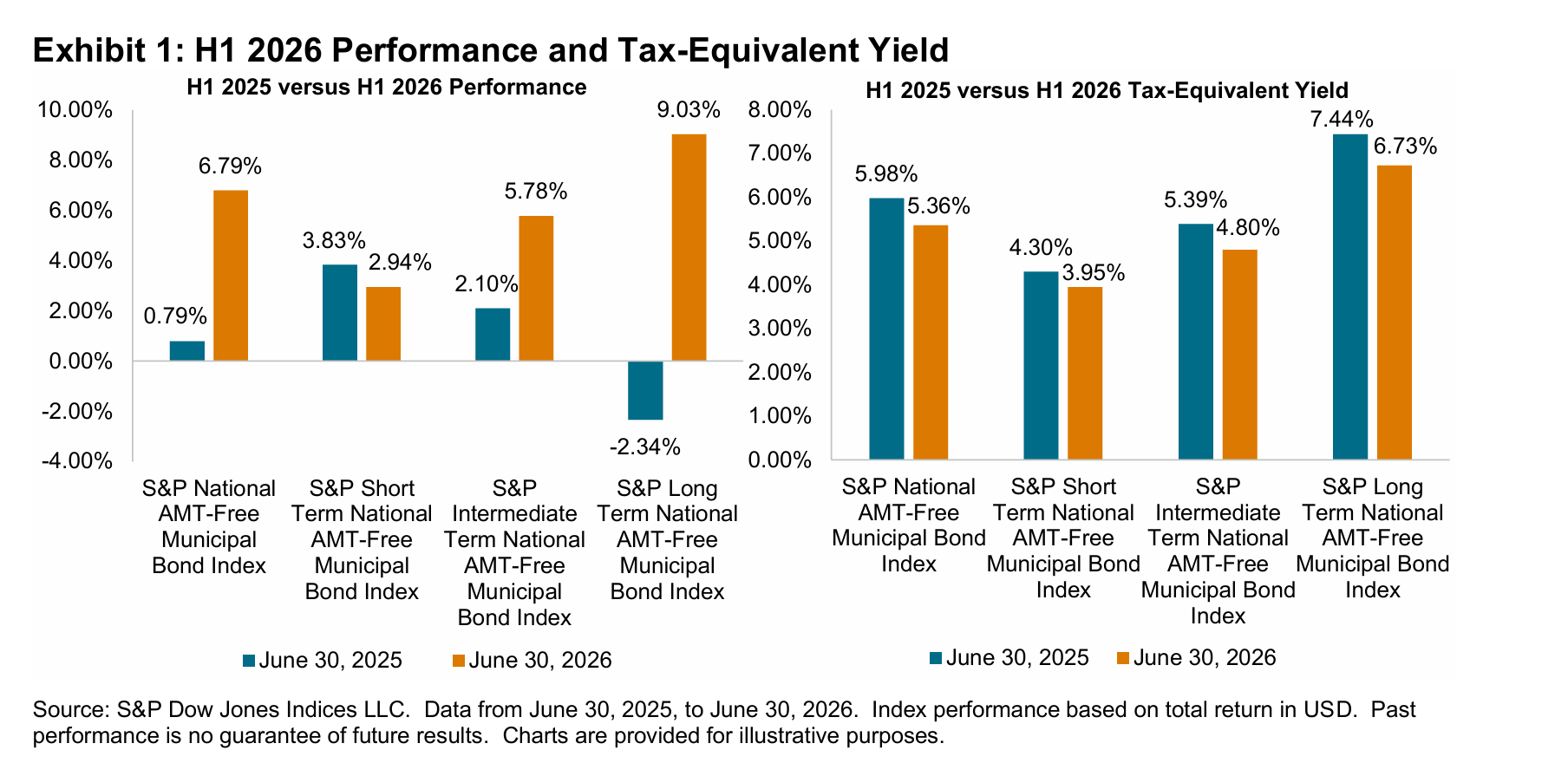
The first half of 2026 marked a sharp improvement in municipal bond performance. The S&P National AMT-Free Municipal Bond Index gained 6.79% for the 12-month period ending June 30, 2026, compared with 0.79% for the one-year period ending June 30, 2025. Performance was strongest at the long end of the curve, with the S&P Long Term National AMT-Free Municipal Bond Index gaining 9.03% in the one-year period ending in June 2026, benefiting from declining yields and heightened demand for longer-duration assets. Tax-equivalent yields declined relative to June 2025, as municipal yields moved lower and the yield curve steepened. The S&P National AMT-Free Municipal Bond Index ended June with a tax-equivalent yield of 5.36%, down 62 bps year-over-year. Similar declines were observed across the maturity spectrum, with tax-equivalent yields falling 35 bps for the S&P Short Term National AMT-Free Municipal Bond Index, 59 bps for the S&P Intermediate Term National AMT-Free Municipal Bond Index and 71 bps for the S&P Long Term National AMT-Free Municipal Bond Index.
Comparing the S&P National AMT-Free Municipal Bond Indices with the iBoxx USD Treasuries Current 10 Year and iBoxx $ Corporates reveals that municipal bonds delivered the most stable performance (see Exhibit 2). Over the past decade, municipal bonds demonstrated competitive risk-adjusted performance across varying market environments. While investment-grade corporates generated the highest cumulative performance, municipal bond indices produced consistent performance with lower volatility and drawdowns. In contrast, 10-year Treasuries significantly underperformed during the period, underscoring the potential benefits of municipal bonds over the long term, while corporates had the highest performance but also the highest volatility.
