












































April 2022 Commentary
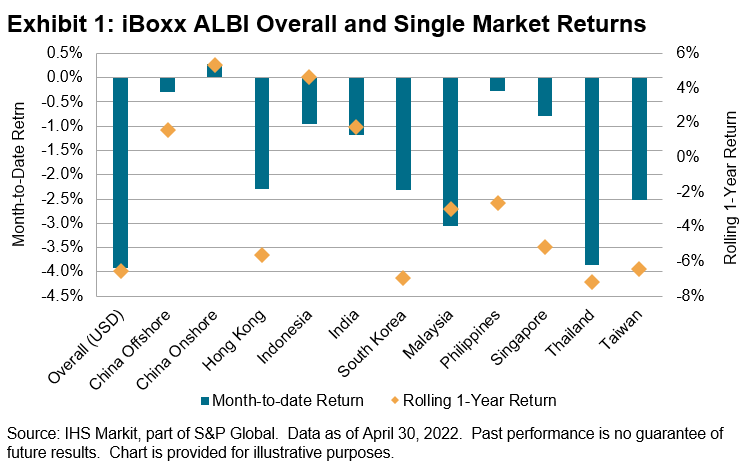
As the Omicron wave of COVID-19 subsided in most parts of the world, border restrictions were either relaxed or removed in a number of countries, and businesses and individuals began to look forward to lives that may somewhat resemble pre-COVID-19 days. This said, global markets did not have the best month in April due to a slew of reasons—including the ongoing Russia-Ukraine conflict, global supply chain disruptions, tightening COVID-19 restrictions in China and inflationary pressures.
Global equities were down 8.15% (as per the EMIX All World Index). U.S. Treasuries fared slightly better but still ended the month down 3.23%. In Asian fixed income, the iBoxx Asian Local Bond Index
(ALBI) (unhedged in USD) was also in the red, losing 3.92%, as all eligible markets except China Onshore (up 0.29%) lost ground. The worst-performing markets were Thailand (‑3.86%) and Malaysia (‑3.05%). Apart from China Onshore and the Philippines, all other markets recorded losses (in local currency terms) across the yield curve. The largest losses were concentrated in the long end. Of these, Thailand 10+ (-7.12%) and Hong Kong 10+ (-6.97%) were notable. On the bright side, China Onshore saw modest gains across all maturity bands.
Through April, the overall index yield increased by 26 bps to 3.99%. Excluding China Onshore (‑1 bp), all other underlying markets saw yield increases, with Hong Kong climbing 56 bps to 3.51%—exceeding 3.5% for the first time since index inception. India remained the highest-yielding bond market in the index, offering 7.19%, while Singapore (2.79%) was the lowest-yielding market.
