










































The Trackinsight Global ETF Survey 2026 depicts an ETF industry moving from access to selection. As the product shelf expands, investors increasingly need to understand not simply what exposure an ETF provides, but what role it performs and which trade-offs it introduces. Options-based ETFs provide a clear example of that shift and are examined in particular detail by the survey.
Options-based ETFs have reached meaningful scale. By Trackinsight’s classifications, the category reached USD 384.3 billion across 1,459 products by July 2026. It took in USD 105.3 billion in 2025 and another USD 77.4 billion in the first seven months of 2026. Scale has been accompanied by a broader portfolio role, spanning income, growth, volatility reduction, downside protection and diversification.
Demand Is Taking Different Forms
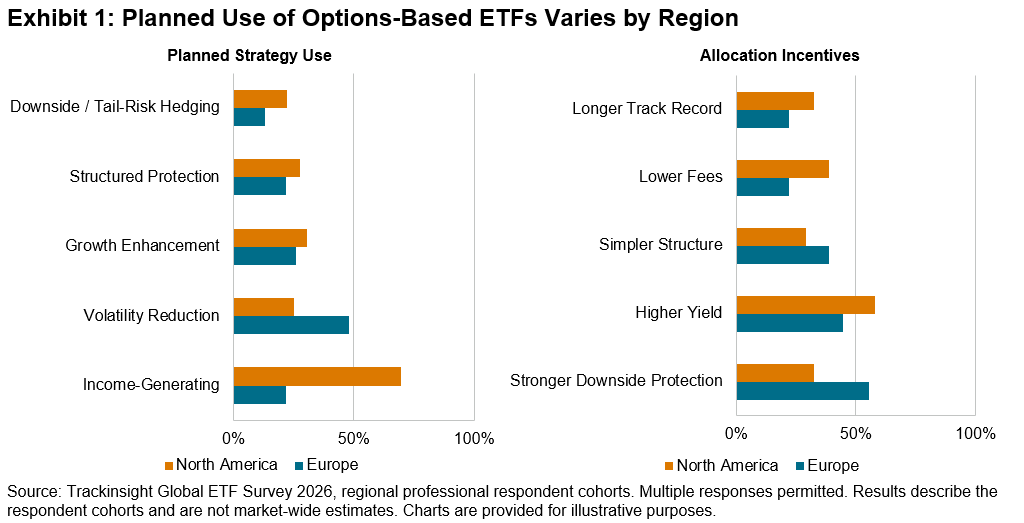
Among the professional respondents included in the regional analysis, 69% of the North American group planned to invest in income-generating options-based ETFs over the next 12 months. The equivalent figure in Europe was 22%. The reasons for that demand also differed. In Europe, volatility reduction led at 48%, compared with 25% in North America. Greater downside protection also ranked highly among the factors for European investors. The regional samples were small, so the numbers should be treated as indicative. They nevertheless raise useful questions about how the options toolkit will be deployed within the industry.
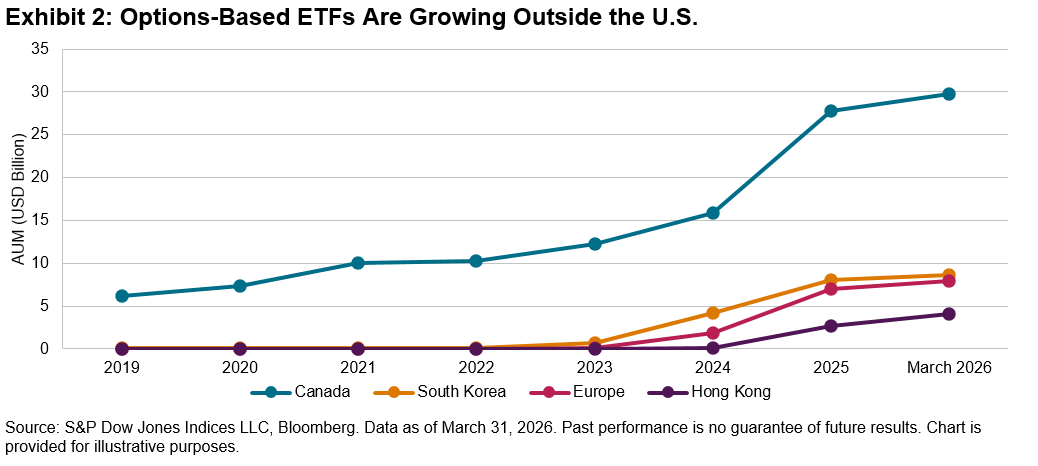
The U.S. remained the largest market, but adoption is spreading internationally. By March 2026, options-based ETF assets had reached about USD 30 billion in Canada, USD 8.6 billion in South Korea, USD 8.0 billion in Europe and USD 4.1 billion in Hong Kong.SS
The product mix varied as well. Covered calls prevailed outside the U.S., but markets differed in their use of active management, index tracking and option underlyings. Canada made extensive use of single-stock options. U.S. indices were more prominent in Europe and Japan, while local indices prevailed in Hong Kong. These markets show how product design is adapting to local demand, regulation, distribution and market structure.
A Global Ecosystem Supports Differentiated Products
Regional objectives and product structures may differ, but many strategies draw on common underlying options markets. The S&P 500® is a leading example. Its options ecosystem spans strikes, maturities and trading hours, including index options, options on futures, options on ETFs and an active over-the-Scounter structured market. This breadth supports daily, monthly, quarterly and annual covered call, buffered, and other strategy designs, with a broad range of market participants contributing to trading and pricing.
Liquidity outside U.S. trading hours has also increased. Average daily traded notional in listed S&P 500 options during non-U.S. hours reached about USD 132 billion in 2025, compared with USD 5 billion in 2014.1 That liquidity can support products designed for different markets, wrappers and reset schedules.
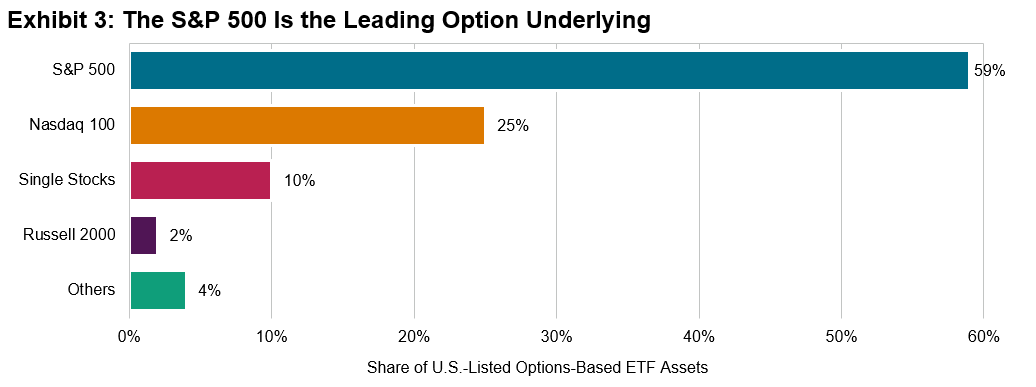
Source: S&P Dow Jones Indices LLC, Bloomberg. Data as of Dec. 31, 2025. Based on reported AUM in U.S.-listed options-based ETFs. Reproduced from “Defining Paths with Options-Based Index Strategies.” Chart is provided for illustrative purposes.
Design choices remain consequential. Strike, maturity, reset frequency and entry point can materially change the balance between income, protection and upside participation. Those choices depend on access to liquid instruments and effective implementation. Trading ecosystems around established benchmarks have therefore supported the development of these exposures in ETFs.
Understanding Remains a Constraint; Indices Can Bring Clarity
Trackinsight respondents cited complexity and unfamiliarity more often than cost or compliance as barriers to greater use of options-based ETFs. The result is understandable. A covered call, a buffer and a tail-risk strategy may all use options, but their expected behavior is quite different. “Options-based” does not indicate which role a product might play in a portfolio.
Investors therefore need to understand the outcome being sought and how the strategy is intended to pursue it. What income or protection is being targeted? Is upside participation reduced or enhanced, and over what period? When does the strategy reset? How might it behave in a strong rise or a sharp fall in the market? Larger investors may also need to consider derivatives liquidity, capacity, collateral, valuation and trading costs.
This is where indices have a distinct role. Established benchmarks can support the underlying derivatives ecosystem. Strategy indices can encode choices about strikes, maturities, resets and protection in transparent rules. Relevant benchmarks can then provide a basis for comparing both index-tracking and actively managed implementations, and for assessing whether a strategy delivered the outcome it was designed to provide.
The ETF wrapper can make an options strategy easier to access. The broad range of indices offered by S&P Dow Jones Indices, both as underlying benchmarks and as transparent representations of options-based strategies, can make a strategy’s purpose and trade-offs easier to understand. As the market continues to innovate, the products most likely to earn a lasting portfolio role will be those whose intended outcomes can be clearly explained, consistently measured and appropriately compared.
Read the Trackinsight Global ETF Survey 2026 for the full findings on how professional investors, including allocators, fund selectors, wealth managers and other institutional investors, are selecting and using ETFs. For a closer examination of options-based strategy design and benchmarking, explore Defining Paths with Options-Based Index Strategies. The Trackinsight Global ETF Survey 2026 was sponsored by S&P Dow Jones Indices.
1 Lee, Sue, “Beyond Borders: The Significance of the S&P 500 in Options-Based Strategies,” S&P Dow Jones Indices, May 4, 2026.
The posts on this blog are opinions, not advice. Please read our Disclaimers.