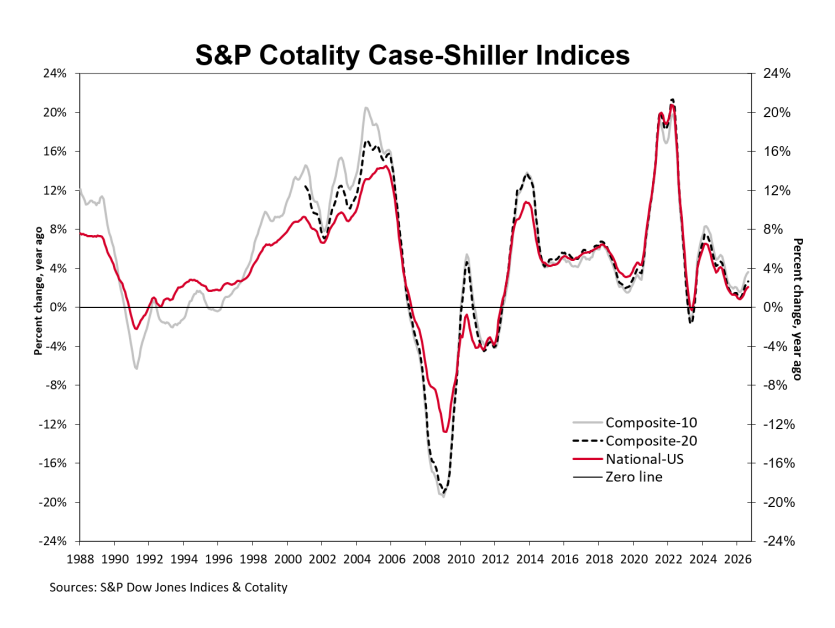










































- The S&P Cotality Case-Shiller U.S. National Home Price NSA Index posted a 2.1% annual gain for August 2026, up from a 1.9% rise in the previous month.
- S. home values fell in real terms for the 15th consecutive month, as August’s 3.4% inflation ran roughly 1.3 percentage points above the 2.1% home price gain.
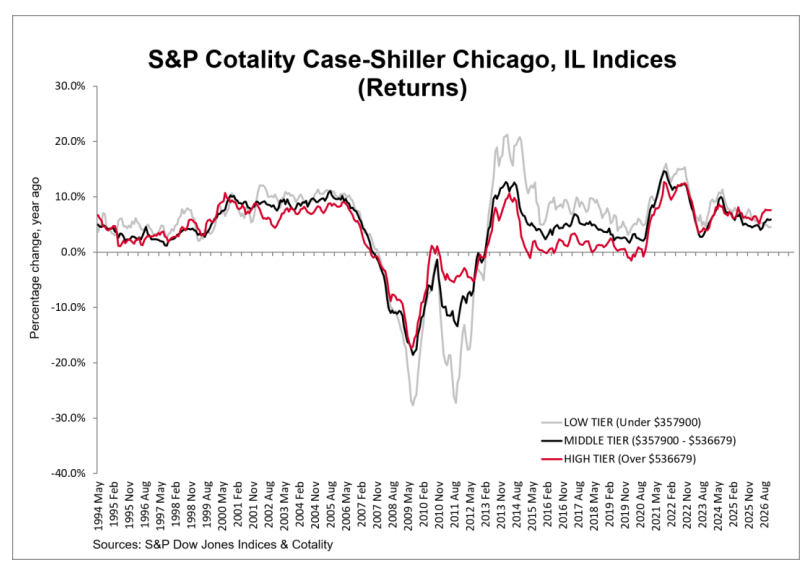
- A nearly 9 percentage point gap separated August’s strongest market (Chicago +6.7% YoY) and its weakest (Seattle -2.0% YoY), underscoring the strong regional divergence in home price trends.
NEW YORK, OCTOBER 27, 2026: S&P Dow Jones Indices (S&P DJI) today released the August 2026 results for the S&P Cotality Case-Shiller Indices.
More than 27 years of history are available for the data series and can be accessed in full by going to www.spglobal.com/spdji/en/index-family/indicators/sp-Cotality-case-shiller.
Cotality continues to have transaction delays from the recording office in Wayne County, the most populous county in the Detroit metro area. These delays impacted the August transaction data and, therefore, no valid August 2026 update of the Detroit S&P Cotality Case-Shiller Index will be provided for the October 27, 2026, release date. There was, however, enough data to calculate a valid July 2026 update, which is provided in Tables 2 and 3.
S&P DJI will continue to provide updates to the Detroit index values for the month(s) with missing sale transactions data.
ANALYSIS
“U.S. home prices declined in real terms for the 15th consecutive month in August 2026, though the gap narrowed as nominal home price growth strengthened,” said Rebecca Kaufman, Associate Director of Commodities at S&P Dow Jones Indices. “The S&P CoreLogic Case-Shiller National Home Price Index rose 2.1% year-over-year in August, up from 1.9% in July, while consumer prices increased 3.4% (the same year over year gain as in July 2026).
“Chicago led all metros for the sixth consecutive month, posting a 6.7% annual gain, followed by New York (6.2%) and Cleveland (4.3%). On the West coast, Seattle recorded the largest annual decline for the third consecutive month at 2.0%, followed by Las Vegas (-1.3%) and Denver (-0.8%).
“Seasonality continued to weigh on headline monthly results. On a non-seasonally adjusted basis, the U.S. National and 10-City Composite Indices fell 0.2% and 0.4%, respectively, while their seasonally adjusted counterparts rose 0.3% and 0.4%. The divergence suggests that the typical post-summer slowdown is obscuring some underlying strength in home prices.
“Affordability, however, remains challenging. With inflation at 3.4%, Brent crude near $100 per barrel and mortgage rates in the mid-to-high 6% range, households continue to face elevated costs alongside persistently high home prices.”
YEAR-OVER-YEAR
The S&P Cotality Case-Shiller U.S. National Home Price NSA Index, covering all nine U.S. census divisions, reported a 1.9% annual gain for July. The 10-City Composite saw an annual increase of 3.4%, up from a 3.0% increase in the previous month. The 20-City Composite posted a year-over-year increase of 2.5%, up from a 2.2% rise in the previous month.
Chicago reported the highest annual gain among the 20 cities with a 6.9% increase in July, followed by New York and Cleveland with annual increases of 5.8% and 4.2%, respectively. Seattle posted the lowest return in July, falling 1.6%.
MONTH-OVER-MONTH
The S&P Cotality Case-Shiller U.S. National Home Price NSA Index, covering all nine U.S. census divisions, reported a 2.1% annual gain for August. The 10-City Composite saw an annual increase of 3.6%, up from a 3.4% increase in the previous month. The 20-City Composite posted a year-over-year increase of 2.7%, up from a 2.5% rise in the previous month.
Chicago reported the highest annual gain among the 20 cities with a 6.7% increase in August, followed by New York and Cleveland with annual increases of 6.2% and 4.3%, respectively. Seattle posted the lowest return in August, falling 2.0%.
SUPPORTING DATA
Table 1 below shows the housing boom/bust peaks and troughs for the three composites along with the current levels and percentage changes from the peaks and troughs.