












































Introduction
For fixed income market participants, higher yields and greater liquidity tend to be important. These objectives, however, typically involve trade-offs between each other. Each structure reallocates risk across credit, rates, funding, basis and liquidity dimensions rather than eliminating that risk.
As discussed in previously published research, market participants have increasingly focused on liquidity, implementation efficiency and portfolio flexibility in a higher yield and more volatile environment. Credit derivatives have become an important component of that market infrastructure, supporting price discovery, risk transfer and portfolio management alongside cash bonds and exchange-traded funds (ETFs).
For market participants seeking scalable exposure and exchange-traded liquidity, fixed income ETFs may offer an access point to yield-oriented markets; for market participants seeking yield, private credit and illiquid segments may provide opportunities for additional income with a similar level of credit risk.
Market participants may also seek higher yields by extending further along the yield curve or by venturing into less liquid segments of the market. However, doing so carries an inherent trade-off in the form of greater duration exposure, heightened volatility or potential illiquidity risk.
Cash income is market- and rate-cycle dependent rather than a uniform source of return. Where policy rates or deposit pass-through rates move lower, cash allocations may become less effective as an income source, increasing the potential relevance of short-duration implementations that retain liquidity while adding diversified credit risk premia.
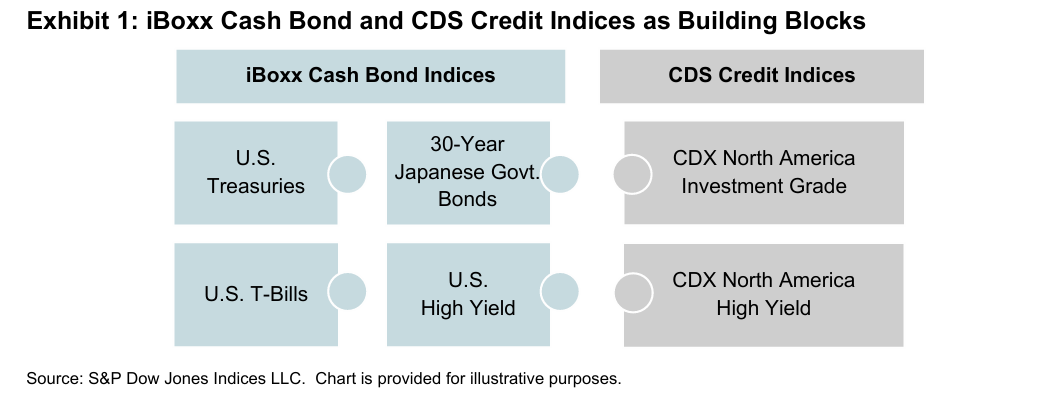
However, there are approaches that seek to increase fixed income yield while maintaining liquidity characteristics and managing exposure to interest rate duration. Rather than viewing bonds as a single asset class, an alternative approach is to decompose them into core components. Tools such as iBoxx cash bond indices and CDX/iTraxx credit default swap (CDS) indices can be used to combine credit risk, duration and yield flexibly, supporting a range of strategies focusing on yield, synthetic income or the isolation of credit risk from traditional bond structures.
The iBoxx CDX ecosystem reflects these broader fixed income trends by providing transparent, rules-based benchmarks for measuring and accessing credit risk.
Consider the sample instruments in Exhibit 1 as modular toolkits that can be combined to unlock a range of possibilities.
The Liquidity Factor
Liquidity is a key consideration when viewing iBoxx bond indices alongside CDS indices such as CDX and iTraxx. iBoxx-linked instruments, including ETFs and standardized total return swaps, and CDX indices are among the most actively traded fixed income tools available today. This depth may help in supporting scalable credit strategies with relatively low transaction costs, even in volatile markets. In 2025, U.S. high yield ETFs tracking the iBoxx USD Liquid High Yield Index traded over USD 806 billion, while the CDX North America High Yield Index recorded USD 4.0 trillion in notional traded, both all-time highs.
