Customer Logins
Obtain the data you need to make the most informed decisions by accessing our extensive portfolio of information, analytics, and expertise. Sign in to the product or service center of your choice.
Customer Logins



QUARTERLY
Aug 02, 2015
New medicines, new headaches: how to pay for innovation

The global R&D factory of the pharmaceutical industry is churning out new, innovative medicines at an unprecedented rate-an incredible record-breaking 44 new medications were approved by the US Food and Drug Administration (FDA) last year alone, with major new advances in treatment for hepatitis C, skin cancer, diabetes, multiple sclerosis, and other maladies seeing the light of day. This year we expect to see two major new treatments for cholesterol management reach the market.
This is welcome relief for an industry that had a few tough years between 2009 and 2013, when major patents were expiring. Consider Gilead Sciences, which developed the hepatitis C cure Sovaldi, seen as the most successful launch in industry history and generating sales of $10.4 billion in its first year. Sovaldi and other new drugs are bringing benefits to a broad range of patients, while allowing their developers to refill their coffers and generate new revenue streams.
However, cracks are beginning to appear in the overall development model for new medicines. The science is becoming so good, and is developing at such a rapid rate, that regulators are struggling to keep up. The average time to market for new pharmaceuticals in key European markets declined by 52% between 2011 and 2015, according to IHS.
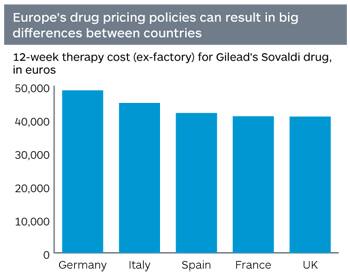
Healthcare budget holders around the world are grappling with how to fund so many new treatments, which are also usually sold at a higher price point than their predecessors. The backlash over the pricing of Sovaldi created a groundswell of criticism from many quarters, not least of all from the US Congress.
The Sovaldi pricing conundrum highlights diverging philosophies in funding healthcare. In the United States, insurance companies and payers waited for competition to reach the market. Once it did, discounts became the name of the game as Sovaldi's competitors sought to secure exclusive contracts with the biggest pharmacy benefit managers. In response, Gilead expects to discount its hepatitis C franchise by an average of 46% in 2015, more than double the discounts from the year before.
In Europe, government price negotiations are the favored approach, producing significant price differentials between countries. Countries with strong pricing systems secured prices for Sovaldi roughly one- third below the cost of the drug in the United States, exclusive of discounts.
While Sovaldi might be the most celebrated recent example, it is by no means a unique situation, where a highly effective treatment is finding it difficult to find a price acceptable to payer and manufacturer: the last five new innovative treatments in diabetes care, for instance, have failed to reach the German market because of disputes over price between the industry and government.
The pricing of new drugs is an area fraught with ethical issues on how to ensure patients get access to the best treatment. If the current rate of innovation continues, scientific advances may outrun society's ability to pay for the fruits of these innovations.
Gustav Ando is senior director, IHS Life Sciences
{"items" : [
{"name":"share","enabled":true,"desc":"<strong>Share</strong>","mobdesc":"Share","options":[ {"name":"facebook","url":"https://www.facebook.com/sharer.php?u=http%3a%2f%2fwww.spglobal.com%2fmarketintelligence%2fen%2fmi%2fresearch-analysis%2fq23-new-medicines-new-headaches-how-to-pay-for-innovation.html","enabled":true},{"name":"twitter","url":"https://twitter.com/intent/tweet?url=http%3a%2f%2fwww.spglobal.com%2fmarketintelligence%2fen%2fmi%2fresearch-analysis%2fq23-new-medicines-new-headaches-how-to-pay-for-innovation.html&text=New+medicines%2c+new+headaches%3a+how+to+pay+for+innovation","enabled":true},{"name":"linkedin","url":"https://www.linkedin.com/sharing/share-offsite/?url=http%3a%2f%2fwww.spglobal.com%2fmarketintelligence%2fen%2fmi%2fresearch-analysis%2fq23-new-medicines-new-headaches-how-to-pay-for-innovation.html","enabled":true},{"name":"email","url":"?subject=New medicines, new headaches: how to pay for innovation&body=http%3a%2f%2fwww.spglobal.com%2fmarketintelligence%2fen%2fmi%2fresearch-analysis%2fq23-new-medicines-new-headaches-how-to-pay-for-innovation.html","enabled":true},{"name":"whatsapp","url":"https://api.whatsapp.com/send?text=New+medicines%2c+new+headaches%3a+how+to+pay+for+innovation http%3a%2f%2fwww.spglobal.com%2fmarketintelligence%2fen%2fmi%2fresearch-analysis%2fq23-new-medicines-new-headaches-how-to-pay-for-innovation.html","enabled":true}]}, {"name":"rtt","enabled":true,"mobdesc":"Top"}
]}